
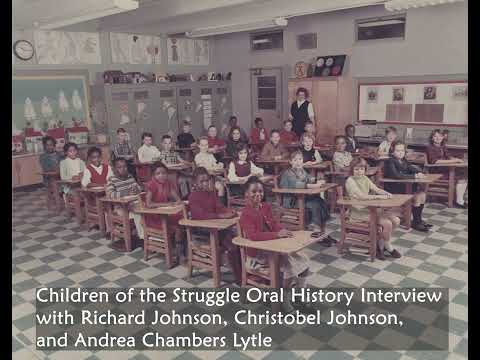
Interview with Richard Johnson, Christoble Johnson, and Andrea Chambers Lytle
Description: Among the first students to desegregate Morganton public schools in 1963, Richard Johnson, Christoble Johnson, and Andrea Chambers Lytle share their stories of racial violence and discrimination.
Richard and Christoble Johnson are the children of Lucille Johnson Rutherford, one of the Seven Mothers. In 1963, Christoble was among the “first wave” of Black students to attend formerly white schools as a result of the Seven Mothers’ activism. She transferred from Mountain View Elementary School to Morganton Junior High for seventh grade, which resulted in being isolated from her siblings and peers as administrators assigned Black students one to a class.
Richard Johnson was among the “first wave” of students to desegregate Morganton High School. His mother sent him to school for a quality education but no one accounted for the hostility and threats he would receive. Richard, Christoble, and Andrea recall the loneliness and rejection of sitting at a cafeteria table only for other students to move away, being served cold food at the end of lunch periods, having to dance alone or play basketball alone. As Christoble states, “We got abused for quality.”
Date: 2022-05-03 Location: Morganton, North Carolina
Interviewer: Leslie D. McKesson; Jeronimo Martin
Leslie D. McKesson: We'll have two --
Christoble Johnson: to look at it
Leslie: Just to summarize this, as I mentioned to you, this came up as a result of doing an article for Burke County Notebook for the Morganton News Herald. The article was about the West Concord Mothers. I think, was it you, Andrea, that told me about Chris or Gary?
Christoble: Jeanie.
Leslie: Jeanie told me? Y'all's mother was Miss Lucille, right? [crosstalk] That's how we got connected, and what I would like to do is just hear your stories, your thoughts, and reflections about that time. What I'm planning to do with it is just to transcribe it, which means just have somebody type up our conversation. Save it for research, for future research, like Chris talked about, writing a book about it. Somebody could very well use this research to write a book about it. There's already a little bit of information that's been collected by the History Museum downstairs. I think there are five or 10-minute interviews, so they don't go into any detail.
Christoble: Yes. That's the information that they did the Mothers with it.
Leslie: Just to add to that and to create a storehouse for these stories. Because what I learned from listening to Andrea, I was in desegregation, but I was on the tail' end of it. I think the little kids got an easier time with it. Some of the stories that I hear are stories that need to be preserved I think so people understood that there was a battle going on with young kids. It was hard for young people. [crosstalk]
Christoble: It was. To me, it's painful. Very, by the way you were treated. UnGodly. Being a child that young, you would never think another human being would stoop to treat you so bad just because you want to go to school and you were another color.
Leslie: Before you start, let me get you to spell your name for me and tell me a little bit about what age you were at this time?
Christoble: Okay. My name is spelled, C-H-R-I-S-T-O-B-L-E Johnson. I was in the seventh grade. I left Mountainview Elementary School, went to the seventh grade, at Morganton Junior High. First of all, there was just maybe five or six of us, and they split us up. You don't have no power if you are separated. They split us up one to a class. You had nobody to identify with. You had nobody to sit in groups with, you had nobody to talk to in class with. You go on a field trip, you were isolated, you sat in the back of the bus all by yourself. They made sure that you got back there because they said, "Get back there." Ooh, God it's awful. I used to wait with the greatest happiness to get out of school and run up to Morganton High where my sister and brother was, for their protection to go home. That was the highlight of my day. The dread of my morning was walking with my brother to school and knowing I was going to leave him, and all my protection was gone.
Leslie: Was that Richard?
Christoble: Yeah. You got to school, You was called a nigger. In class. When they talk about slavery, they'd say, the nigga. We say, we not niggas, we negroes, and they'd look at you like, "That's what you say." They didn't try to talk about it, correct it, they'd just go right on. You didn't have no voice. You didn't have nothing. That was all. It was even worse walking to school. If I went alone, my brother had to go somewhere or my sister, I had to go alone. To walk from Bouchelle to there, I was just as scorned by the blacks.
Leslie: Why was that?
Christoble: Because they said my mother thought we were too good to go to school with them. Mountain View was just right below my house. Instead, I had to walk with them. Mountain View was just right below my house. Instead, I had to walk across town. They said, why would Miss Lucille send y'all across town when school's right below your house? You had to be bullied to get past the black section, to get up to the white section. You could be cruelly bullied and treated cruel. There was no place for me.
Leslie: Then how long was it from when y'all went early to the white schools?
Christoble: The next year.
Leslie: It was the next year? [crosstalk]
Richard Johnson: Yes. It was total integration.
Christoble: That's why it was so hard on us because they said, "Why can't you wait?" Everybody said, "Why do you think y'all so good, y'all can't wait." Then if we were out of school and Morganton Junior didn't have school, we had a free day, and you sitting excited about seeing the black kids coming from school. They didn't want to be bothered. They'd call you names too. They talk pure junk too. "You too good, they'd snub you."
Leslie: Did y'all-- [crosstalk] Go ahead, Andrea.
Andrea Chambers Lytle: I feel your pain because--
Christoble: It was painful.
Andrea: It was painful because like I said, a lot of people wasn't aware that Central was a school for the white folks, and that's where I got sent.
Christoble: I didn't know about that school you went to.
Andrea: Central.
Christoble: Central? I didn't know about Central.
Andrea: Robert Forney, myself, Beverly, and Marilyn was the only full blacks in that school.
Leslie: Tell me what grade you were in
Andrea: That's when I had left Mountain View and then they told me I had to go to Central. I had finished Mountain View at fifth grade, and I should have been going to sixth grade at Central, but that's when they put me in a special ed along with Robert Forney.
Christoble: They put him in special ed too?
Andrea: We were in a class taking care of the developmentally handicapped children from the folks that lived on Riverside Drive for two-- Well, it was actually two years that I felt that they stole from my life.
Christoble: Yes. You feel like they--
Andrea: A psychiatrist came in and would give us these little ink blocks test.
Christoble: They gave them to us too, them ink blot tests.
Andrea: Each time I passed the test and she said, "Mm, something's wrong." Then she'd come back the end of the year, I think I had it three times, it was on that third time she admitted that they made a mistake. I'm saying, "You made a who?"
Christoble: You done spent that time in there.
Richard: Where was the Central school at? Right here in Morganton?
Andrea: Where the courthouse sits. They got a picture of it. Of your article, the picture is there.
Richard: I didn't know about that.
Christoble: I never saw it till I saw the picture. I didn't either. Jeannie was telling me and then I. ..
Andrea: It was sitting right there where the Courthouse sits in Morganton. Then when she came back and said, "Well, we made a mistake." I said, "Well, what you going to do about it?" That's when she said, "Well, we have to talk to the principal and get with your parents and discuss it." What they ended up doing-- I said, "Well, why can't you just put me in the grade that I should be in?" She said, "We can't do that." I said, "You can't do that?" I said, "Y'all made the mistake, not me." Then she said, "Well, we'll see what the principal has to say." What they ended up doing was putting me back into fifth grade because they said that the school year was halfway over and that's where you need to go.
Christoble: That's how you ended up a back grade?
Andrea: [crosstalk] Yes. With Gary Dean. With Debra O'Neil and all them. Because I would've been ahead of you, but I got put back then.
Christoble: I always wondered how you got with them. She would've been ahead of me. They got people put back two grades.
Richard: That was a wasted two years of your life, though.
Andrea: Yes. Two years of my life stolen. That's the way I feel.
Christoble: It was stolen.
Andrea: It was stolen from me, and the only thing they could say was, we're sorry.
Christoble: Well, they didn't tell us they were sorry, they just looked at us with a snarly face. Well, you come into class, they just snarl--
Andrea: When I say they sorry, it was the principal and the-
Christoble: The school?
Andrea: - psychiatrist and those people were saying they're sorry, but to me, that's not-- I just couldn't accept it. It hurt. It hurt for a long time.
Christoble: That stuff, it does hurt. That to me, they did-- We did not make any progress. We regressed two years. Because even after integration came, we still had to go back the next year before we even got looked at as a person.
Andrea: That is so true. Then when I did go back for that half of a year, and then the next year I did go back to Forest Hill with my siblings to the sixth grade. Then when I went on into the junior high school, that's where like you, I had problems too.
Christoble: My Morganton Junior High years, that seventh, eighth-grade year is so-God, it was so damaging to me. It killed me inside because you had to be just treated so bad and suffer in silence.
Andrea: Yes, and the teachers wouldn't come to your rescue. They would let them kids call you every name under the sun.
Christoble: But the right thing. They'd leave you in the room with them by yourself.
Andrea: You'd go and she'd tell another student, "Well, go help her with this," with a math problem.
Christoble: They wouldn't help you.
Andrea: The student would come and call you a nigga.
Christoble: [laughs] They wouldn't help you.
Andrea: That anger got into me, and I said, "Well, guess what, I'll see you after school."
Christoble: That's what it ends up, you fought.
Andrea: As soon as I got away from Morganton Junior High school, got up by Morganton High School, because like you said, your brothers and other friends-
Christoble: Those were your siblings.
Andrea: - that's where you'd go for protection. Then once I got up there, I was walking behind her and I tapped her on the shoulder and I said, "Remember what you called me?" [chuckles] She looked at me and she said, "Nigga?" That's when Ipow
Richard: The fight was on?
Andrea: It was on, but she didn't fight me back.
Christoble: No, they wouldn't fight back.
Andrea: They ran back to the school and told the principal, and the principal contacted my parents and my mother said, that's when you going to-- If you don't stop this, you're going to the reformatory school," and I said, "That's what they say. Right?" [laughs] They say.
Christoble: That's what my mother used to tell us, "You just have to go through." They was trying to practice Martin Luther King's non-violence.
Leslie: Oh, yes, yes.
Christobel: They just "Don't be out there fighting-acting, that's what they want you to do so they can kick you out of school."
Andrea: We heard that a lot too.
Christoble: You just don't know that back then, if my mother hadn't instilled in me about carrying a weapon, I'd carry a gun to school. I really would've. If back then, and there was guns in the house. I knew if I carried a gun, Lucille would kill me. She'd kill me dead. There is times I could have carried a gun in school, in my book bag, and killed them. Every one of them. To shut them down, and wouldn't have felt a bill of pain.
Andrea: How did it occur-Probably once y'all got to the ninth grade at Olive Hill
Leslie: Tell me about what year it is, if you can.
Christobel: Okay. '64, '65, '65-- '66, '67, things began to change. We got to West Concord. Well when we got to West Concord was only ninth graders. Segregation was on the swing. There was a lot of Black students, there was a lot of white students, and the Black students decided we going to beat the hell out of them if they look at us wrong. We done took enough. We'd go to school, you'd be walking in a crowd, they'd take scissors and cut your sweaters and clothes and you'd turn around and it's like, "Stop hanging off of you." So, we decided we were going to get them back. We went to they lockers and took they stuff out.
Andrea: Ripped it up.
Christoble: One good turn deserves another. Well, that didn't go over too good, we got in trouble. Because they would always punish us for doing stuff.
Leslie: Did the white kids get in trouble?
Christoble: No, they never got in trouble. A lot of them, they parents, they carried clout. They could do whatever they wanted to [crosstalk] us and we didn't get it. They didn't do nothing. Then we got the ones from Roper Street and Bouchelle Street that was gangster-like. [laughter]
And it was on and popping. We had our gang, "Y'all are white, but we over here. It might be a little group but we all-- We got you." It kindly panned out-- It remediated itself, but the worst thing was we lost so many students. They quit school.
Richard: Yeah.
Leslie: Quit school?
Andrea: Dropped out.
Christoble: It was very detrimental to education. It didn't improve education. A lot of black students that would've done things with themselves, and we could've gone farther. I might've gone farther with my life, but school became a dread.
Richard: The teachers wouldn't assist you. If you were having difficulty learning something,
Andrea: They wouldn't.
Christoble: We were already behind.
Richard: They would help the White students in need of assistance.
Andrea: But they wouldn't help us.
Richard: They'd make excuses for you, "Oh, I can't do it today, maybe tomorrow you come by."
Christoble: They'd keep piling the work on and on.
Richard: I almost got discouraged and quit going. I was one of the first of five of us to go to Morganton High, integrated Morganton High. Myself, Charles Forney, Eugene Thomas, my sister Lorraine, just the first five of us.
Christoble: And Diane Tate, did Diane go?
Richard: Patricia Thomas.
Andrea: Yes, Patricia.
Richard: I hear a lot about this person went and that person went, but there was only five of us at first. [clears throat] Our mothers got together, and they decided that we needed a quality education.
Christoble: They didn't ask me.
Richard: They had more advanced curriculum books and stuff than we had. Whenever they finished with the books or whatever, it was passed down to us, but it'd be out of edition like five years or something. They thought that they sent us to a school that we could get a quality education and that was the whole concept, but once we got there, we found out that they didn't want us there.
Christoble: They didn't like it either.
Richard: It's really hard to try to concentrate and learn whenever you're in a hostile environment. "Leave your notes on your desk. Nigga, go back to Africa."
Leslie: Oh my Gosh.
Richard: Take it out their nose and wipe it all over your notes. It was rough going to school every day.
Christoble: People don't know. They don't know.
Richard: You would get threats that, "We'll catch you walking in the hall or something." It was hard to go to school and take a test if you had all that outside stuff you had to worry about. And the ones of us that survived and made it though.
Christoble: They did. Got by the grace of God.
Richard: It was worth it because we endured a lot. We endured a lot.
Christoble: Even during the cafeteria time, if you noticed, all the blacks was on the last lunch run. [crosstalk] Food always ran out.
Leslie: You were always scheduled at the end of the last shift.
Christoble: The food, the good food was gone. We always got-
Andrea: Leftovers.
Christoble: We'd go down there-- That's why a lot of us would skip class and go to the cafeteria. They would give yau a study hall so that you wasn't in the main flow, then we'd have study hall, and then we'd go to lunch. Not when the blacks was there. The food, if they had French fries, we got tater tots maybe and they wasn't done and cold. The food was not of good quality either. They always shifted us to be at the end.
Leslie: What were your classrooms like? Was there more than one black person in the class or were you kind of sifted--
Andrea: [crosstalk] Two at the most.
Christoble: It might have had two at the most.
Richard: At the high school, I was the only one.
Christoble: Yes, wouldn't have been ...
Richard: In every class I had, I was the only one.
Christoble: It wasn't no better at the high school.
Richard: It was difficult to.
Andrea: That was after everybody came over.
Christoble: They still managed to keep us split and no power, not to rise up.
Richard: Like you were talking about the lunch, you'd get your lunch and you sit at the table at a seat and three or four people get up and move to another table.
Christoble: Yes, that's right.
Richard: It was difficult.
Christoble: You had to eat alone, play alone. Let me tell you, at West Concord, we had dance. The teacher paired us. They called out your name, there's your partner, go stand with your partner. I was wondering who the world am I going to dance with. Because those little boys say, "I'm not dancing with no nigga." They said that right away. I know I wasn't going to dance with no boy, and they didn't have no black boy in my class. I sit there wondering what's going to happen today. They gave me the Kay-- Her name was Kay Lathop. She had a gland disorder. She was-
Andrea: Huge.
Christoble: - huge. You remember Kay? She was very huge. They didn't like her either. They put us together. She didn't like me, because she didn't like "niggas," but you know what? She began to kind of had to put up with me because she was my dance partner and we had to get a grade together. I'd tell her, "Come on, let's go get this grade," and she'd dance. She never spoke to me, she never looked me in my eye, but we danced.
Richard: If one did take it upon himself to try to be friends with you or whatever, and you're walking down the hall, "Nigger lovers." [laughter]
Christoble: You had to hear "nigger lover." [laughter]
Leslie: What happened to the black teachers when desegregation happened?
Christoble: They were just disqualified because we didn't have any.
Andrea: We didn't have any.
Christoble: We didn't have any.
Richard: Well, McIntosh ... with the high school.
Andrea: McIntosh was the only one that I could associate in the ...
Christoble: Identify with
Andrea: - middle school.
Even in the ninth grade, I don't even recall the black teacher at Olive Hill.
Christoble: We didn't have one.
Andrea: Not one.
Christoble: McIntosh was only [crosstalk]--
Richard: [unintelligible 00
Christoble: They used him to keep peace with us.
Richard: Yes, that's it.
Christoble: He was a token peacemaker because if we got out of order, they'd call him. If they had a student that wasn't acting right, being layed off school, they'd call him, and he'd get in touch with the parent. He was the liason, what you call it, because they didn't take no time with us.
Richard: Like my sister was talking about, we had dance too. We had ballroom dancing every Friday. I'd get the basketball and just go to-- Because we had it in the gym. I'd just go to the end of the gym is your basketball cause wouldn't nobody dance with me.
Leslie: By yourself.
Andrea: That's what it was with us.
Richard: I guess we had like maybe a month and a half left in school and this girl came up too, her name was Susan Fitts. Her daddy used to own the News Herald. She came up and she said, "I think it's been horrible the way we were treated y'all here." We only had maybe a month and she said, "If you don't mind, I'll dance with you ." Hell, I wanted to shoot basketball. [laugher]
Anyway, after that, I didn't have a problem on Friday getting somebody to dance. Because once somebody stepped up and danced with me there, on a Friday somebody else would volunteer. There was only two or three Fridays and school was over anyway. The whole year I had to shoot basketball.
Christoble: I had a guy like that in my class, his name was Bobby Phillips. You remember Bobby?
Andrea: I remember Bobby Phillips.
Christoble: He burned in a fire but one day we was in class and the teacher left out and this white girl had bullied me and I was there just looking at her. She was just calling out her niggas and stuff, and the rest of them, "Yes, yes," like that. Bobby said, "Why y'all treat them like that? If I had my way, I'd kiss her." [laughs] It made me feel good that he would say that. He said that trying to make them leave me alone. After that, he'd look at me and try to be my friend, but they wouldn't let him be my friend.
Andrea: I recall one teacher at Olive Hill when I was there. She was a PE teacher, her name was Miss Brendel.
Christoble: I remember her.
Andrea: One day she came up to me and she said, "Don't let them get you down." She said, "Keep smiling." She said, "Because you're going places in your life." I took that with me the whole time when I was going through this--
Leslie: All that trauma.
Andrea: Yes.
Christoble: She was young.
Andrea: Yes, she was a young teacher.
Christoble: Because she came to Morganton High and taught English to me. I was I her home room. She was very good. They dogged her, she got pregnant out of wedlock, and they dogged her--
Andrea: Oh, yes. You didn't do that back then.
Christoble: Back then they made her leave.
Leslie: We had two teachers in our high school [crosstalk] that would take extra time with me. Both of them were females and they would take extra time. One teacher, I'd sit right in front of my desk, and they'd leave notes and everything and she never, Oh, I don't know who loves that note, Richard. I'd say, "How in the hell can you sit there and not see who'd take something to wipe on there?" Who cannot see him do that?
Christoble: She didn't want to see. They didn't want to see stuff like that.
Richard: I guess they closed their eyes or some they looked the other way.
Christoble: It's almost like if they were caught trying to defend us, they will get in trouble. They'd never seen nothing. They never heard nothing. They didn't know nothing.
Andrea: Did you ever get paddled in school? It seems like it was always the blacks that got paddled in school.
Christoble: Especially in Morganton Junior High, Mr. Patton, I hated him.
Andrea: Thank you. (laughs]
Leslie: Now did the teachers do it or did they send for somebody?
Christoble: Send you to Patton. He had a long paddle, brown and it was thick.
Andrea: You had to bend over. Touch your toes.
Christoble: You had to bend over and he'd hit you with that paddle. He'd hit you with that paddle. Because I got hit with it a couple of times for talking back to a student and they said I was wanting to fight. I was wanting to fight but I ain't hit nobody.
Leslie: Was it a white student you were telling that to?
Andrea: They whipped us more than they did the white children. They really did.
Christoble: They abused us.
Richard: I didn't get threatened too much by the guys.
Christoble: I guess not. [laughs)
Richard: I could defend myself pretty good. I didn't have much problems with that. It was just leaving notes and threatening you. Like she said, if you hung your coat up in the closet, they'd go in and, pockets full of water, anything --
Christoble: One day was the coldest day, it was snowing and sleeting outside. I went to get my coat and it wasn't in my locker and Daisy Robison say, "Christoble, I think that's your coat in the bathroom in that last stall. Go look." I went in and looked. Somebody put it in there and pooped on it.
Leslie: Oh my Lord.
Christoble: The coldest day.
Leslie: Oh my goodness.
Christoble: I was hurt so bad because I kept thinking where's my enemy? That's what I want to know. What enemy? It never did come out. Beverly Tucker, my best friend, I put my arm in this coat, my hand around her waist, and she put her arm in that way, then we went walking with the hood, our heads together. It was real uncomfortable, and went home. That's how I got home.
Andrea: They used to do some horrible things.
Christoble: My mama said, where's your coat? I said, "They put it in the toilet and pooped on it." She got me a coat, but she was very disturbed by it. She said, "Did you tell anybody?" Ain't nobody-- Man, they ain't--
Andrea: They're not going to listen. They're not going to listen.
Richard: She called and raised a little hell about it with the principal.
Christoble: She called and she'd go out there to the school, said she didn't expect us to be treated that way, but that just didn't help none.
Richard: To get a quality education we had to put up at a bunch of mess.
Christoble: We got dogged to get quality. We got abused for quality.
Richard: It was rough.
Leslie: Do you feel like the quality actually improved? You've talked about how hard it was to sit and take a test when you dealing with somebody putting boogers on you.
Andrea: On your desk.
Leslie: On your desk and stuff like that. Did the quality improve for y'all?
Richard: I think for the children maybe eight years later, six years later, it started, but the first two or three years, I don't think so.
Christoble: I don't think it did us any good because my class in 1971 still has a class reunion and don't invite the Blacks?
Leslie: What?
Christoble: To this day?
Andrea: My class actually, I ran into Buddy Armour, I was in class with Buddy. He just told me this past weekend, he said, "We need to meet and have a class reunion." I do recall the last class reunion that I attended at Morganton, it was after I got back from Chicago and some of the students that betrayed me when I was in middle school and high school were there. One came up and actually hugged me. Oh, Andrea, it's so nice-- Elaine Sites. I said, "That's the one that called me a nigga." [laughter] I said, "I'm above that now." It was strange how they act like they knew you so well and now they were loving up to you and I just said, "I'm not going to stoop to their level. I'm a different person now."
Leslie: Have any of them ever apologized?
Andrea: No.
Christoble: No. We had our class, Loretta Putin. Remember her?
Andrea: I remember.
Christoble: She'd been organizing our class reunion they said, for years. Kathy Smith that works at Blueline, she told me. I asked her, I said, "When?" She said, Loretta was talking about having another class reunion, she said. I said, are they thinking about inviting any of us this time? She said, "You know how Loretta is." It ain't changed.
Andrea: This would be our 50th.
Christoble: We supposed to have our 50th, but we don't have a class. I'm kindly glad the school's tore down.
Leslie: Not good.
Christoble: Because now I don't have no reminder.
Leslie: Man.
Christoble: It's like it's a relief. Let me tell you this, do you know the class of 1948, I think it is constructing a wall out there in that field somewhere, but they supposedly don't have nothing for the Blacks or integration because they said they wasn't involved in that.
Leslie: Morganton High School Class of 1948?
Christoble: They said they're constructing a wall, but they don't have nothing-- They want nothing to do with the integration movement with that part. They want us to buy brick now, but we don't know where we're going to put it.
Leslie: Where's this wall supposed to go?
Christoble: Where the old school was, somewhere up there. [crosstalk] old apartment. To mark the spot [crosstalk] right here, the spot that they said that the class of that year, 1948 or whatever it is, I can't get the detail. Gary Harbison knows, but said that they don't want to get involved in the racial part. We still ain't got no part.
Andrea: Of course.
Richard: I think our mothers had a very good idea and a wise plan to try to get better education for us. Not necessarily, I don't think it happened for us, but I think down-
Andrea: For generations to come?
Richard: - the road because of what we-
Christoble: Even now.
Richard: - endured and went through, I think the kids underneath us, when they started coming up, it was a lot better.
Christoble: A whole lot better.
Richard: A lot of them got quality education but at first whenever we went, we just caught hell.
Christoble: Now that I think about that too, they like each other, they started growing up together. A lot of them have remained friends that belong-- They have benefited from it. Because a lot of them, White and Black have remained friends, they went to school together.
Leslie: You're talking about the younger kids?
Christoble: The younger generation.
Richard: Younger generation. Our mother's efforts didn't go to waste.
Leslie: It paid off?
Richard: - worked out but it was years later before the actual idea they had in mind started to--
Christoble: Spread it and work in this town.
Richard: Started to take effect.
Leslie: That's an excellent point. Because you hear these stories of how hard it was on you all. We tell stories about people who sat at countertops or got arrested or whatever, y'all lived with this every day for however long. This was every day in kids.
Richard: That's right.
Christoble: In your formative years.
Leslie: In your formative years, when your identity and self-worth is formed.
Christoble: Your self-esteem and everything is building, and they tell you, you nothing.
Leslie: Wow, wow. There was a great sacrifice that you all ended up making as young people that paved the way for people who came later. Because my experience wasn't like that. I don't know if I ever had one of my white classmates call me a nigger.
Richard: Are you from Morganton?
Leslie: I'm from Lenoir.
Christoble: Oh, God. It was worse over there.
Leslie: Yes. I remember the older kids having the police spraying them with mace and stuff like that, but it didn't trickle down to my age group. I think the kids who hit that first got hit with a brick.
Christoble: Yes, we did. Then too, even at sporting events and stuff, that first year, we wasn't welcome, Black people was playing. They didn't really want--
Leslie: They wanted your people to play.
Andrea: Yes. They wanted your people to play.
Christoble: They wanted them to win. [crosstalk]
Andrea: What hit me again was when I played basketball in the ninth grade, and I got to play in the 10th grade. Then that's when they came and told me and said, You can't play on the team anymore because you're too old. That was because--
Christoble: They done put you back all that time [crosstalk]
Andrea: Two years and then now you're going to take what? The sport that I'm interested in away from me. You can be the manager on the team, but I want to play basketball. That hurt again. You threw a rock at me again.
Christoble: The cheerleaders, we didn't have any cheerleaders. We had girls with big mouths. I tried out for cheerleader, they didn't take me. That was my first year at Morganton Junior. My second year in eighth grade, I tried, but they didn't take me. Anyway, when we got to Morganton High, we wanted some cheerleaders of color because our boys was playing. We needed some color. They wouldn't give us nobody, so we walked out of school. We went to Reverend Mack, told him about it, and he told us, he said, "Be calm. Do it organized. Go over to Slades Chapel, sit on the steps, and I'll meet you up there." He dared the boys to leave and get to drinking wine, you how boys do. He said, "I want everybody on the--" We were going to leave there and walk to the Board of Education and let them know our complaint. The day we left, those teachers, "We glad you niggas is gone. Leave." Slamming doors, telling us, "Go. Don't come back. Good riddance."
Leslie: Well, now tell me about what happened when y'all went over the Slades. How did that go?
Christoble: When we all went over there and we started singing songs, "We Shall Overcome" and all the songs called Martin Luther King was doing that time. We started singing those songs. Rev Mac came and he prayed with us, and he told us to go single fil e, the Board of Education then was out there by Teeters, where Whole Foods is. We walked out there. He let us join there in the office, but there was only him and another student to speak.The superintendents were there then, and he went in, talked to the superintendent, and told him what was going on. Everybody was running crazy, wanting to know What's going on? What's going on? He told him that we needed some cheerleaders. We were tired of the way we were been treated and we were demanding a change. They gave us what, three? Ruthie, Viola, and ...
Andrea: Wasn't Ruth Roseboro?.
Christoble: Ruth Roseboro, yes.
Andrea: Was a cheerleader.
Christoble: We ended up with three cheerleaders, and when they seen that, things started to change a little. The pressure wasn't as bad, but it still wasn't good.
Leslie: You had to push for everything you got. Nothing was a given.
Andrea: It wasn't given.
Christoble: To even have a locker, you had to push. You had to be verbal. You had to show strength. You had to just to be able to say, "I'm here. Recognize me."
Richard: I think it helped me out in the long run because after high school, I was in the military, and I stayed 30 years. There's prejudice in the military too. Not only against Blacks, but Hispanics, Asians.
Christoble: Anybody who ain't white.
Richard: Coming from Morganton taught me to how to cope with it and deal with it.
Christoble: It did.
Richard: I stayed in the military for 30 years, so I think it really helped me a whole lot.
Leslie: There's a whole skill set you had to develop because you were a person of color.
Richard: That's right.
Christoble: That's so true because it helped me.
Andrea: Me too.
Christoble: When I left and was gone 28 years, it helped me.
Leslie: Where did you go?
Christoble: My husband was military and like my brother, we just went everywhere, around the world and back. The greatest joy I've ever felt about being a Black American was when I was in Germany. This communist told me, he said, "You go home, you American-ish." I said, "That sounds better than you go home, nigga." [laughter]
Andrea: It happened to me over in France.
Christoble: He didn't like me because I was American.
Andrea: They didn't like me over in France because I was American, not a Black person and I kept saying, "Oh my God." [laughter]
I'm American. [laughter]
Richard: They accept you a lot better over there.
Christoble: They do.
Richard: They accept you a lot better.
Christoble: They just talk about you--
Richard: You're a human being to them, you're not a person of color. They treat you like a human being. Even Morganton High, there was some that I look forward to seeing in the morning so I'd go to school but there was some that treat me real nice. If I went to an auditorium, I had two buddies that would come and sit with me. They had to take the, "Nigga lover," but they still held their heads up high and sit with me.
Leslie: Stepped up. What year did you graduate?
Richard: 68.
Leslie: 68. And you were?
Christoble: 71
Andrea: 72
Leslie: Okay.
Christoble: When he left in '68, my oldest sister already gone. That was my only link of protection.
Leslie: You were going by yourself at that point?
Christoble: I had a younger sister when I grew up.
Andrea: That was in my grade.
Christoble: That meant that I was on my own. It was kind of scary.
Leslie: You mentioned one time that you walked to school and sounded like you were leaning on the protection of your brother.
Christoble: Not leaning, I was dependent on it.
Richard: It was a long walk too. [laughter]
It's a long walk there. Yeah, long walk.
Christoble: Come from Bouchelle. You know where Bouchelle, Mountain Recreation? All the way across town, down through there, and going to Morganton Junior High.
Leslie: Oh gosh, that is a long way.
Christoble: Rain, sleet, snow or hail, you had to go. We didn't ride no bus, we walked.
Richard: I tell you something else, too. Being at Morganton High, we had to walk home every day. We went by Woolworth's, it could be pouring down rain.
Leslie: Where was that?
Andrea: Where the Kimbrell's building is.
Christoble: Where Kimbrells is.
Richard: You couldn't go in no store. If it was raining, scared the cold, no. Y'all are still-- Stay outside. They would not let you in the store,
Christoble: The Whites would come up the sidewalks full force and we'd walk, had to get off the sidewalk, and get in the street.
Andrea: That's the way it was coming from Morganton Junior High trying to go home to West Concord Street.
Christoble: All the way.
Andrea: They would push us off the sidewalk coming down the sidewalk, clapping their hands. (singing) "We hate niggers. We hate niggers."
After a while, we got fed up with it. Candace, Revelee, and myself was the main ones that would be walking that route after we left school and they would actually start that song again, "We hate niggas." I said, "Candace, I'll tell you what, you see that guy right there, he's mine." I said, "That girl with her, that's mine." I said, Now, the rest of them y'all can do whatever.
Christoble: You had to do that.
Andrea: We fought until they finally would depart and let us walk through.
Christoble: That's what they did to us going down the Bouchelle. We had to go through there like a ram rock. You had to go to through-- You'd get tired. A bunch of you'd get together and just hold up to your-- And just go through-- Who wants to live like that?
Leslie: Gosh.
Andrea: Then they would run home, tell their parents. Their parents would call the school and then our parents would come down on us.
Christoble: The police would be more visible. When things like that happen, just intimidate and scare us? The police walking.
Leslie: The police would come around when--
Christoble: After we done had a confrontation.
Andrea: Because we were the one that fought.
Christoble: Because we decided we got enough. They said we was aggressive, we was fighting them. They don't talk about how they would come up and we had to get inside, and you get tired. When we got tired, like y'all, we ram up together and just go run down through them like they bowling balls and knock them. Next day or so, the police-- You know what that's for.
Andrea: They were running up and down the street helping them out.
Richard: I seen the time that it'd be raining cold, and you could not go in the store. If you were one or two, but if you're in a group--
Andrea: You can't go in.
Christoble: Especially don't go into Roses or Woolworth. Whoa.
Andrea: What you talking about? [chuckles]
Richard:
Christoble: If you go get something to eat, you had to go down the counter and they'd go, "We don't serve niggas here." We had to go over at Dave Rader's to the Green Fly, we called it. The little back door? And get a hamburger.
Richard: He wouldn't let you in, either.
Christoble: He wouldn't let you in either, nasty joint. But if You go through the back door you get a hamburger for a quarter. (laughter]
Leslie: The Green Fly? [laughter]
Richard: That's what we called it.
Christoble: It was Dave Rader's Cafe. We could go there and get a sandwich, but you'd go to the back door.
Richard: Yes, we called it The Green Fly.
Christoble: It was a little run down and it be-- The best thing about it, that little Black man in there cooking, he'd bring you a sandwich and get your $1 whatever. Then you go to the movie-
Andrea: You got to sit in the back.
Christoble: - and they'd pee in cups and throw them on you.
Leslie: What?
Andrea: Yes, we had to sit up at the balcony at the Mimosa Theater.
Christoble: They'd be over on the other side. They'd pee in cups and stuff and throw them over on top of you.
Leslie: Oh, my goodness.
Andrea: We couldn't come into the theater, we had to go up the back door.
Christoble: Up the steps.
Andrea: Up them steps up to the back of the--
Christoble: You had to stand there and knock on the door. You had paid your money, but you couldn't go.
Richard: Somebody would come up from downstairs and ran up there and open the door for you.
Andrea: Open the door.
Christoble: Then you paid down here for your ticket, but you'd come out, go outside
Andrea: Go up inside the building and go ...
Christoble: - go up the step and go up that little side door. You might miss a part because they come get you when they get ready.
Leslie: Wow.
Richard: I don't think people in Alabama, Mississippi had anything on us. Except we didn't turn the other cheek too often. [laughter]
Enough was enough.
Leslie: Well, how did your mothers-- How did they respond to that? To the way you all were being treated?
Christoble: They always felt it will get better. We were the sacrificial lamb.
Richard: My mother always told me, don't let anyone hurt you. They try to physically hurt you, you have to defend yourself.
Christoble: That was it.
Andrea: That's what my father always told me.
Christoble: Yeah, "Don't start it, but if you have to finish it, you finish it. Don't let them hurt you. Don't let them do nothing Because I'm with you ." My mama used to say, "I got you. I got you." They didn't want us to bully-- Just go start-
Andrea: Don't start stuff, we didn't do that.
Christoble: - They said, "If they do something, you better take them out."
Andrea: That's what my daddy used to tell me.
Christoble: That's why I tell you, back then l'd've carried a gun to school.
Richard: It was rough.
Christoble: You felt like carrying a stick-- If you had a stick you could fold up and pull out. [laughter]
Andrea: pull it out. [laughter]
Leslie: Take some nun-chucks or something to school with you? [laughter] Wow.
Christoble: It was horrible.
Richard: I gave an interview one time over here in the library. I don't know if they still use it or not.
Andrea: I bet it is. I got one.
Christoble: A lot of people said that they heard your interview and they said they really liked it. Brenda Brewer told me said, "Richard told it just like it was."
Richard: To believe that people who do that actually do that.
Christoble: They'd do anything to you. The things that you would be shamefully to say, they didn't care.
Andrea: Exactly.
Christoble: They didn't care what they-- You didn't put nothing past them either.
Richard: Then if you had a big exam, you had to go home and all the stuff you're going through during the day and try to study and concentrate. It's hard. It's very difficult.
Leslie: No doubt.
Richard: Very difficult to prepare yourself for a test.
Christoble: I couldn't stand Put, either.
Richard: Me neither.
Andrea: You know Put?
Christoble: I couldn't stand him.
Andrea: By the time I got to my senior year, I got used to Put.
Christoble: I couldn't stand that white guy.
Andrea: Prior to that.
Leslie: Now, who is Put?
Andrea: Mr. Putnam
Richard: We had a Ku Klux Klansman [crosstalk][laughter]
Christoble: He had the hat on and the robe and everything right there in class. [laughter] This is how he walked. You've seen Mr. Tudball on Carol Burnett?
Leslie: Yes.
Christoble: He didn't have no personality, didn't have nothing, and he'd look at you and call you nigga as to look at you.
Andrea: You know he was never--
Leslie: What was he?
Andrea: He was an instructor.
Christoble: He a North Carolina teacher. You had to pass his class to graduate.
Andrea: He always called me High Pockets, he never called me by my name.
Leslie: Oh, my goodness.
Andrea: He called me High Pockets because I was on the basketball team at the time. He will always say, "Well, High Pockets, how many points are you going to hit tonight?" High Pockets this, you know, but never addressed me by my name.
Christoble: He didn't address any of us with any kind of curtesy,
Leslie: So rude.
Christoble: He didn't address you, and he'd say, "You. Hey you." I'd just look at him and say to myself, "I hate you."
Leslie: You said a lot of kids just dropped out. About how many would you think just couldn't take it and dropped out?
Andrea: I know my sister Anna, she dropped out of school. By the time she got to the high school, she dropped out.
Leslie: Now, where would Annabella [her sister, Anna] have been?
Andrea: Would have been in Morganton High School when she dropped out. [crosstalk]
Leslie: She would have finished in--
Andrea: She would have been in 1970.
Christoble: A lot of the students that dropped out were students that came from-We were all poor, but came from-- They was poorer than us. Because they were made fun of so bad-- One thing about our parents, they worked hard and tried to clothe us and do the best, but you had some that came from a real, real lower poverty level than where we were. They couldn't take it. They went to the Black school, the teachers, everybody knew they situation, everybody tried to help. They would give clothes. I remember we had a student, they father left them, and they was bringing clothes-- My mom told me, "Take these clothes down in to school." I took them to Miss Hamilton's room, they was giving clothes and stuff-- You knew about things and nobody was a failure. When they integrated the schools, they didn't have any help. Then they got sneered.
Andrea: See on West Concord Street, most of the families were large families. Mildred had seven girls, and my family, there was seven of us. I was the middle of seven.
Christoble: I didn't know they were seven of y'all.
Andrea: There was Roy Irvin, Annabel, then me, then Jeannie, Gary Dean, and-
Christoble: I never know because I spent so many nights out there, it seemed like there was so much room. [laughter]
Andrea: Rose Johnson, she had about six or seven.
Christoble: That was four of us.
Andrea: There was a lot of-- West Concord was a big family. Bobby Forney, they had a big family. [crosstalk] The whole street was-
Christoble: The whole street was big ....
Andrea: - big families but we were one united family.
Christoble: See, we would go over there because like Ruth and them was our cousin...We'd go spend the night with each other and you go out there in the street and you just play ball with kids everywhere, but excuse me, when we started going to school.
Leslie: That dynamic just changed.
Christoble: No, we remained the same because we had to replenish our strengths. On weekends, all of us would get together and have a game plan going on. We got to get them. The Blacks, the seven mothers-- The kids I think were always close. Then the seven mothers joined together for us to have a better education. When school was out, we clung to each other because we were going through the same thing. We didn't have no place in the Black world and the White world, but we had each other.
Leslie: Now, help me get it right about that first year. That first year, y'all went for a while.
Christoble: The whole year.
Leslie: Did you go the whole year?
Andrea: Yes. [crosstalk] Integration went the whole year.
Leslie: lntergration was the following year. Okay.
Christoble: The seven mothers sent their kids in '64. lntergration came fu ll-fledged I think '65.
Richard: We was at Morganton High for the whole year with just me being the only in every class. There was only five of us in Morganton High. It was hell for the first year. The next year, everybody came so, it kindly took a lot of pressure off of you, but the first year was hell.
Christoble: Because the girls like Daisy and all of them that bullied us little people, they became my friends. We was all bullying them. [laughter]
Andrea: Because my daddy told me, he said, "If you come home one more time telling me about what Daisy had done to you."
Leslie: Now Daisy's Black?
Christoble: Yes. She was black, but she was a big girl.
Richard: Yeah, she was a big girl.
Andrea: He said, "I'm going to whip you."
Richard: Daisy used to play football.
Andrea: I didn't want no whipping from my daddy, so I had to whoop Daisy.
Leslie: Oh my.
Andrea: I had to whoop her, really whoop her! [laughter].
Christoble: Daisy was bullying us, we were good to her. Used to kill me [laughter] And she was kin to us. And she ... "Give me your money." After Daisy got to Morganton High, Daisy was helping us bully them. [laughter]
Leslie: She had to change.
Andrea: Change her stripe.
Christoble: Her bullying style.
Richard: You had the help the next young. The name calling, like by myself at Morganton High, I could be walking down the hall, and somebody just holler out but when they came over next year, you do that and somebody standing close to you, you may get a hit upside the head. The name-calling died down. They might tell you one-on-one if you are in a room or outside or something, but as a group inside you paid the price.
Leslie: Because you weren't by yourself. You weren't vulnerable at that point.
Christoble: You know that jewelry store, Gregory Jewelry, their son was Steven Gregory. That was one of the racists.
Richard: That's my classmate.
Christoble: He was a racist and he's crippled.
Leslie: Oh, my goodness.
Christoble: Crippled bad. He hated Blacks, I think. He was mean in school. He'd kick at you as to speak to you .
Richard: There was several of them like that.
Andrea: That Richard Elmore is the one that stepped on my foot and pushed me into the locker. I went to the teacher, I followed them to his classroom, and I went to the teacher and I said, "One of your students just pushed me into the locker. Didn't say excuse me, stepped on my toes." I said, "What you going to do about it?" She's looked at me like I was crazy. Politely, I walked up to him at his desk, Deborah O'Neil and Alice Kay can confess to this, and I slapped a pee out of him. Excuse my French. Then I went back up to the middle of the class and to the teacher's desk and I said, "Excuse me for disturbing your class," and walked out. They said--
Christoble: That's one thing--
Leslie: What'd they do to you?
Andrea: They didn't do anything. They said, "Well, you're going to have to go to the principal office." I said, "well Abernathy don't want to see me." [laughs] Alice said, "If Mr. Abernathy say something, said Jamie Pearson, and all of them going to come up in here."
Christoble: We start sticking together when they stopped getting us together.
Richard: Even though the following year we all came over. I was already there, but everybody else came over, I think a lot of black kids still didn't get the education, the assistance that they needed.
Andrea: They didn't.
Richard: The dropout rate for the first three or four years was probably pretty high.
Christoble: It was.
Richard: We had a lot of black students in schools because of one reason or another, they couldn't get help. They quit school. Which they may have been doing it to try to see if we're going to quit anyway. They've done it on purpose not giving us any help and eventually they quit, dropping out. They still dropped out, but not at the rate probably the first two or three years.
Christoble: Because it was horrible.
Andrea: I look at it too like when in the sporting events, the black guys that could really play football, they catered more to them than they would-
Christoble: Caraway.
Andrea: - the other ones.
Christoble: Caraway, but he helped a lot too.
Richard: He did. I liked Caraway.
Christoble: He helped a lot. He took time or his-- Because I had him in science, math, something, and coach Caraway would take the time. You'd go to him, he would take the time to explain. I think it's because he was a coach, and the diversity of the team, he learned how to deal mainly with everybody. Certain ones you could go to and talk to. He was one of them that made you go to him.
Leslie: When you went to him, what could he help you do?
Christoble: He would help you put it into perspective. You could even tell him how they were treating you and he would say something like, "I know. I'll try to do something." He wouldn't push it away under the rug. He would acknowledge it. Sometimes you could see a little change. Sometimes we'd have a program in the auditorium saying that wasn't going to tolerate certain things and everything, but it didn't change.
Richard: He always told me if you played football for me, I'd get you a scholarship.
Christoble: He did. He got a lot of boys scholarships.
Richard: He was sincere about it. He liked to see athletes excel as a student and a player.
Christoble: One thing about it, he didn't try to shade their grades so they could play. He stayed on them to get the grades. He was a real teacher.
Richard: The administration above him, they're the ones who probably held him back a little bit.
Christoble: Then we had a principal at Morganton High. I liked him, Laughinghouse, his name. We called him Haha. [laughter]
So we could talk about in his face, say "here come, Haha." We'd see him coming down the hall, his name was Laughinghouse. Somebody doing something, we said, "Haha you better quit." The thing about him, and like I said, we had lunch last, 11 o'clock we had study hall. What we would do, if you went to study hall and stayed in there 10, 15 minutes, and get counted present, they'd take the roll and you get counted present. What we would do was go down there by the football field and sneak out that hole, there was a hole in the fence. We'll sneak out that hole in the school and go to Hardee's, Hardee's is right at the road to eat. One day Haha was down there waiting on us. [laughter]
Leslie: He had the last laugh that day, didn't he?
Christoble: He just turned us all around.
Leslie: You were able to eat at Hardee's?
Christoble: We'd slip out.
Leslie: I mean they would serve you?
Christoble: Yes. We could go there and get a burger.
Andrea: Hardee's was right down the hill here.
Christoble: On the street here. It was right across the street. Then they had Warlick's Grocery. They had Warlick's Grocery there. We could go, you'd take-- We could get cookies. Like two for a penny and stuff like that. I'd eat something. We'd eat peanut butter cookies and stuff. Then they have ?-Eleven above, at the turn. A lot of times we'd go in there and spend our lunch money and buy a bunch of junk. Because we didn't get a quality lunch.
Richard: And all the cooking staff were black anyway.
Leslie: Were they ever able to slip you a little good stuff?
Christoble: They would sometimes. [crosstalk] If we are cold outside or something like that, they'd try to get you.
Richard: What year did you graduate from Lenoir?
Andrea: 76.
Christoble: You did good.
Richard: They'd improved it a whole lot.
Leslie: Yes.
Andrea: I was in college then.
Christoble: I was in Germany in '76.
Andrea: Graduating from college.
Leslie: I remember stories that my older cousins, I remember one of them was at Lenoir High one day and they were getting maced. The police were literally macing them, spraying them with mace. I don't know what had gone down, and like Morganton, Lenoir tried to keep it out of the news. They didn't want anybody knowing this stuff was going on here.
Christoble: You look at Morganton tried to make it like it was a smooth transition and all was good.
Andrea: It was not that.
Christoble: It was not. It was horrible.
Richard: Yes, it was. It was.
Leslie: Because they didn't ask y'all.
Andrea: Nothing.
Leslie: It was smooth from their standpoint, maybe.
Christoble: It was scary anticipating when mother came and told us what was going on, I was scared.
Andrea: You and me both.
Christoble: I was scared. I didn't think-- I was like, "What's going to happen?"
Richard: I didn't pay any attention to them. [unintelligible 00
Christoble: You had a culture shock.
Richard: Real culture shock. When I came up here and gave an interview, I think the guy's name was Claude.
Leslie: Claude Sitton.
Christoble: [crosstalk] That's the one I said.
Andrea: That's the one that interviewed me.
Richard: He was surprised when I told him.
Andrea: He was surprised when I told that story.
Richard: He said "I never knew it happened to you guys."
Leslie: See, that's the thing. The story that was told publicly was smooth transition.
Andrea: Yes, sir, but it wasn't.
Christoble: That's why they kept us one to a classroom without interruption, so it seemed like it.
Leslie: Divide and conquer
Andrea: Like over at Central, like I said I would never see Beverly and them but entering the school and leaving the school. I'd been in that school for a year and a half and never saw them.
Christoble: You didn't even see them in the cafeteria. The way they had us going to lunch. You didn't even see each other.
Richard: He told me one time, Claude did, "Why didn't you go to the principal and the teachers?" Hell, I said I did.
Christoble: That's one of the...groups-[ laughter]
Andrea: There you go.
Richard: You go there two or three times you don't get any help, why continue to go to them?
Leslie: What's the point?
Christoble: You get snarled at for coming and then they like, "What you doing?"
Richard: Oh, you a troublemaker.
Christoble: So why you going to go in there?
Leslie: When you do go to them if anything's done, for the most part, it's done against you. Instead of on your behalf.
Christoble: It's retaliation-
Leslie: It's retaliation.
Christoble: - for you coming. Because you're supposed to suck it up and go on, why are you telling this.
Leslie: Jeronimo, have you got any questions? [Crosstalk]
Christoble: Were you born here?
Jeronimo Martin: I was born here. I think you know my mom.
Andrea: I was getting ready to ask you. Veronica?
Jeronimo: Yes. She's my mom.
Andrea: I kept saying, Jeronimo. When you said that, I kept saying, I know that kid, but you're not a kid. I said, "That's Jeronimo, that's Veronica." I knew his parents and his grandparents, and I remember when he was a little baby.
Leslie: Oh my goodness.
Andrea: I watched him grow up.
Christoble: The reason I ask you if you were born here is because sometimes when I see other cultured people, I can imagine sometimes what they go through because of what we-- I do. I look at them sometimes and I feel sorry for them. Some of the way that some of them are treated. You can go to a laundromat or somewhere and just be sitting and just to watch people, how they treat other people, it just tears me up.
Andrea: Thank you.
Leslie: And that still goes on.
Christoble: That's going on really big. It's big with people that's of another nationality
Richard: As long as you have people, you're going to have discrimination.
Leslie: For one thing or another. If they can't discriminate on color, they'll find something else.
Richard: Even in Africa if it's all Black, there's discrimination.
Leslie: By tribe.
Andrea: It don't matter where you go.
Richard: It's something that you have to learn to deal with. You don't let it get you down too much. You make sure you're not physically hurt from it but you have to learn to deal with discrimination. It comes in all different sizes, all different flavors.
Christoble: It's there. That's another thing too but it is true with discrimination.
Jeronimo: That's right.
Richard: Rich and poor, young, discrimination against the poor.
Christoble: Discrimination against the sex of people.
Richard: Discriminate on obese people, discriminated against-- It's just something that you have to accept as a part of life and not let it get you down. Do the best you can to cope with it and move forward.
Andrea: That's true.
Christoble: This African guy told me one time. We was talking about, I told him, I said, ...my Africa and everything. I said that way somebody-Why don't we go back to Africa and stuff? He said, you're not a true Black person. I said I know. He said, "You don't even know who you are." I said, dog, you got to be discriminated against them too? They going to tell you don't even know. You're just a old mixed-up hot dogs. [laughter]
All different kind of meat.
Leslie: That's it. That's about the size of it.
Richard: This is home. Even though I don't live here now, this is home. I grew up here and it will always be home.
Andrea: You're right.
Richard: This is what I went through and what I had to endure. This is still home.
Leslie: It's helped build you into who you are.
Richard: Yes.
Christoble: Yes, all of us, I believe.
Andrea: We go away. We come back. We say we ain't coming back, but we come back.
Leslie: But you do. Now where do you live?
Richard: I live in a town called Graham, right below Greensboro. I'm moving back this way though, to be closer to home. I am a two-hour drive one way. As I get older and stuff, driving's getting harder and harder for me and my wife.
Leslie: Getting closer to home.
Richard: We've got to move closer back this way.
Leslie: That's good. Well, I tell you what, I appreciate y'all being willing to share these stories.
Christoble: It felt good coming out.
Leslie: Good. It's something that our young people need to be able to have access to in the future when they get to the point where history is of interest to them. Because a lot of them in the younger ages, it's no big deal, but further down the road, it'll become a point of interest. Having these stories preserved, I think, is just-You think of the stories that we lost about our grandparents and great-grandparents because nobody told those stories. So trying to capture those.
Richard: Based on what we went through during that timeframe, you can imagine what they actually went through, our grandparents.
Leslie: Say it.
Christoble: Ooh, what you talking about?
Leslie: Say it. Just to think about the things they endured that we will never even be able to imagine, things they wouldn't even talk about. At least now, we have developed that voice where we can have some freedom to talk about it where they didn't have the freedom to talk about it. They might get lynched-
Christoble: That's why they sang.
Leslie: - if they talk about it.
Andrea: That's why they sang. That's why they sang.
Christoble: They sang their blues away. I felt like singing them. [laughter]
Richard: Just now, several states, a majority of states have voted for the hate law. It's still hard to believe that some states are having a problem trying to pass that.
Leslie: Pass that, isn't that amazing?
Richard: Here it is, 2022, and some states--
Andrea: They're trying to take us back.
Leslie: They want to block it.
Christoble: They don't want to us to have nothing. No quality of life that's worth anything. I just can't seem to understand how they feel that they could be so superior? How do you feel that you brought people here screaming and hollering. You come here on a ship, cutthroat thieves, and robbers, and then you go steal people from they land, bring them here to work for you, and you think that you're so superior.
Leslie: On land that was stolen from other people to begin with.
Richard: You can't steal land that's already occupied.
Christoble: They come here, like I said, cutthroat robbers and thieves, and then they just took over. Just think about that Wall Street. Have you looked at that about the Black Wall Street?
Andrea: Yes.
Christoble: There's another one down in Atlanta.
Leslie: There's one in South Carolina too.
Richard: That information that you're compiling, what are you going to do with it?
Leslie: Yes. I was just going to pull us back to that. What I'm going to do is, we're going to turn it into a transcript, going to have somebody type it up so it will be available. I don't know if I'm going to add it to what they've got here already, share it with the North Carolina Room with Laurie over at the library. Maybe both. I just want to compile all this information and have-- It might make more sense to do it here since there's already a collection started. To have it available for people. Because when I was doing my doctorate, if I had had this kind of information, that's what I would have done it on. I would have studied this deeply. I know somewhere down the line somebody is going to pick up on this and want to do a deeper study of it. Somebody might-- You mentioned, Chris, writing a book. There will be information that's publicly available that they can use for a book. I mentioned that a friend of mine that gave me all this fancy equipment here is very interested in it. She's with Appalachian State University, she might want to do a documentary. If y'all are willing to share your contact information, I'll get that from you, like email or whatever you want to share with me in case somebody wants to do that. They can reach out to you. Particularly Beth, because I know she likes to get people in and talk to people oneon- one if she does a documentary. If you're interested in doing that, let me get you to put your contact information there. Also, I didn't get you to say your name. I got Chris, but Richard, if you'll say your name and Andrea, say your name. Then just let me know that you consent to us recording and using your story for research purposes.
Richard: Okay. Richard Douglas Johnson Junior. [laughs]
Leslie: All right. That does it.
Christoble: I appreciate it. I feel better. Sitting here with everybody and talking about it, I feel better.
Leslie: Good. I think I may do another story for the News Herald, just telling y'alls-Talking about those first kids that went that year alone.
Christoble: I would appreciate that.
Andrea: We really were alone.
Christoble: I would appreciate that. Reason I would appreciate it because they only talk about the ones that went to Morganton High.
Andrea: Thank you.
Christoble: They never bring out the ones that went to these other schools, Morganton Junior High.
Andrea: They didn't know our story. A lot of people didn't know our story.
Richard: I didn't know about yours [Andrea) going to the courthouse.
Christoble: A lot of people don't know our story.
They don't know our story. They only know their story, Morganton High. They focused on Morganton. My brother, my sister, Eugene Thomas, and-
Richard: Patricia Thomas.
Christoble: - Patricia Thomas
Andrea: My brother.
Christoble: - and Charles Forney.
Andrea: My oldest brother, I was sitting there talking about when you and I met and he said, "I could tell them some stories." I will ask him if I can give him your--
Leslie: Yes. If there's anybody else you think would like to talk, share that information with them.
Christoble: I talked to Rose Largent, she's one of the mothers. I talked to one of her daughters and told her that I was going to give you her phone number, but she's gone to-
Andrea: Aruba.
Christoble: -Aruba. She gone so she won't be back for about a couple of weeks I'm gonna say to get her back. I was going to give you her number. She told me it would be okay to give you the number. Then she's got, Miss Annie J. Hicks, her children live on the same street right in front of her.
Andrea: Let's see Kenny is then back in--
Christoble: He's back in Maryland?
Andrea: Yes. He's back up in Maryland. I have his email address. I'll contact him and see if he will talk to you about his experience. Who else? Roy. Even Tudy, that my brother is married to, Tudy Tucker? She shared some insight that I had never heard about. Even just going from Bouchelle to Morganton High School and
Christoble: It was a chore.
Andrea: - it was a chore. We'd sit there one evening and just talk and I said, "Well, I didn't know that this happened to you all too. I thought it was just me." It's not just me, there's others out there.
Christoble: There's others out there.
Richard: The high school was a focal point. That's what everybody was focused on, the high school. Because there were five of us going down and we got most of the publicity, but it wasn't what everybody thought it was.
Christoble: I know they thought it was [unintelligible 01
Richard: Out of five of us, I think me and Patricia Thoms are the only two that's still living. The other three-
Andrea: Did Patricia--
Richard: - Eugene Thomas, Charles Forney, and
Christoble: Lorraine, my sister.
Richard: -and my sister, Lorraine. Of all people, I forget my sister?
Christoble: They deceased.
Richard: They deceased. Me and Patricia Thoms are the only ones that's still living.
Andrea: Now Irvin was in your class too, right?
Richard: Yes, he was in my class too.
Andrea: He was over there.
Christoble: Irvin didn't come?
Andrea: Irvin is deceased.
Christoble: Was he? He wasn't dead then?
Andrea: No, he should have been there with you.
Richard: He went to Olive Hill that last year.
Andrea: Oh, they kept some at Olive Hill?
Richard: No. I guess it was his choice.
Christoble: He wouldn't go.
Richard: He didn't want to go. Because there was only five of us.
Leslie: He did his senior year, finished on out of Olive Hill? Is that what he did?
Richard: No. The next year, everybody went to Morganton High.
Leslie: Okay, got you.
Richard: At first, it was only five or six-\
Christoble: Here's Rosetta's number.
Leslie: Okay. Thank you.
Christoble: She's gone to Aruba but I told her-
Leslie: Rosetta Ferguson.
Christoble: She said she would meet with you, she said "Yeah, I'll talk to her. I think everybody wants to get a little bit of that off their chest.
Leslie: Yes
Richard: All these years later, it's remarkable how you even just relive those memories.
Christoble: It's so intense.
Andrea: Yes, it does.
Richard: It comes right back up.
Andrea: When somebody brings it up.
Christoble: Yes, like you were there again.
Andrea: It comes back full force, "Oh, I'm reliving this over again."
Christoble: It is. It's reliving this over again. And it comes from here.
Leslie: Well, does it help to tell your story-
Christoble: It does.
Leslie: - after all this time?
Andrea: It really does.
Christoble: Because we've suffered in silence. We suffered among ourselves, but to be able to speak it and know that people are going to know, it's like a relief. It's how I feel, it's like a--
Richard: Just the memories of how people treated back then, you wouldn't treat a dog like the way we were treated.
Andrea: They felt it was okay to treat you like that.
Christoble: They felt that's what we deserve. We didn't deserve no humane treatment.
Richard: Trying to get a quality education, "Go back to the way you were living or something." It was pretty rough. It was pretty rough.
Leslie: Yes. Well, I am so thankful to you all for doing this. Because it's a story that needs to be remembered and told and thought about. It really needs to be thought about. Oh, if you consent. Give me your consent so I can have it on the tape. Since I'm not doing all that written stuff that we do at universities. Andrea, I need your name.
Andrea: Okay. Well, people call me Andrea and Andrea so whatever you prefer.
Leslie: Spell it.
Andrea: A-N-D-R-E-A Chambers Lytle, L-Y-T-L-E.
Leslie: Now, what do you prefer? Because I go back and forth between Andrea and Andrea. What do you prefer?
Andrea: I'm going to tell you like I tell everybody else, I'm not hung up on the name. If you call me Andrea, I will answer. If you call me Andrea, they call me Andrea.
Leslie: You answer all of them.
Andrea: I just respond. I'm not going to go-
Cristoble: I always go for Andrea.
Andrea: If it sound close to it, I'm going to accept it.
Leslie: It stands. [laughter]
Christoble: Now, I'm the opposite. They call me Christoble. Well, just don't call me no Crysta-bell, ain't no bell on the end of it. You can call me anything, just don't call me Crysta-bell. [laughter]
Leslie: You spelled your name for us at the beginning so we'll have that on the record.
Christoble: Yes. because everybody messes up.
Leslie: I was going to say, you got to help me make sure I get that right.
Richard: Mr. Johnson, you have my consent to use this information too.
Leslie: Thank you.
Christoble too.
Andrea: Andrea. You have my consent to use this information.
Leslie: All right, thank you. Thank you all so much. This has been amazing.
Christoble: Christoble Ferguson, you have my permission as well.
Leslie: Thank you. Thank you all. Well, I hope you all have a wonderful rest of your day.
Andrea: You as well.
Leslie: I'll let you know when the next piece of the story runs and try to save you a copy of it.
Christoble: Oh, please. That would be wonderful. Let me know when it runs because I'm going to buy paper to send to my friends, "Go get your pain out." [chuckles]
Leslie: Get ready to sniffle and cry and you know they do an electronic version of it too that you can get it online, but the thing is you've got to be a subscriber.
Andrea: Most of the time that's it, you have to be a subscriber.
Christoble: I've enjoyed this [unintelligible 01
Leslie: Yes, I enjoyed it too. I've gained some insights just from listening to y'all that never even thought of.
Christoble: Rosetta told me said, "You know who ramrod all ... ?" Because I was talking about how bad it was. She said, "You know who ramrodded all this?" She said, "Lucille and Mildred." [laughter)
She said, "You know Lucille and Mildred was the ones that ramrodded"
Leslie: Got it all going.
Christoble: Yes, I said them two.
Richard: Their intentions are real good. Years later, they started benefiting but not at first when went...
Christoble: Now their children. We felt like, "They threw us in the bull pen."
Richard: We were guinea pigs to experiment to make it better.
Andrea: Well, Jeronimo, tell your mother I say hello.
Jeronimo: I will.
Andrea: All right, and you take care of your sister. Good seeing you again.
Jeronimo: Good to see you as well.
Christoble: Wasn't this good? We need to have a seven mother party and get everybody together.
Leslie: Have a reunion.
Richard: For the seven mothers.
Leslie: You sure could.
Richard: Good to see you [to Andrea]
Andrea: Likewise. Take care. It's good to see you.
Christoble: Leslie, thank you.
Leslie: Thank you all. Appreciate you. [crosstalk].
Jeronimo: Well, thank you, guys.
Andrea: Now, is this where you go down to the Carolina Room?
Leslie: I think it is.
Christoble: Oh, can we get out that way?
Leslie: Yes.
Jeronimo: Do you need any help with this?
Leslie: No. It'll be a quick tear down. Thanks so much, Jeronimo. I appreciate you.
Jeronimo: See you.
Leslie: Okay.
Jeronimo: Have a good day.
Leslie: You too. [background noise]