
Interview with William F. McIntosh and Robert Caldwell
Description: Reverend W.F. McIntosh and Robert Caldwell speak with Claude Sitton about their experiences of desegregation in Burke County schools.
Coach McIntosh grew up in Marion, South Carolina and moved to North Carolina to play football at Johnson C. Smith University. After graduating and serving a few years in the military, he accepted a position at Oak Hill High School teaching math and coaching football. Coach McIntosh also taught typing after school until typing was added to Olive Hill’s curriculum and taught physical education until a teacher was hired.
Robert Caldwell was one of Coach Mac’s students and players at Olive Hill. He played football in the Shrine Bowl in 1957 and also grew up in the same neighborhood as Coach Mac.
Date: 2012-01-05 Location: Morganton, North Carolina
Interviewer: Claude Sitton; History Museum of Burke County
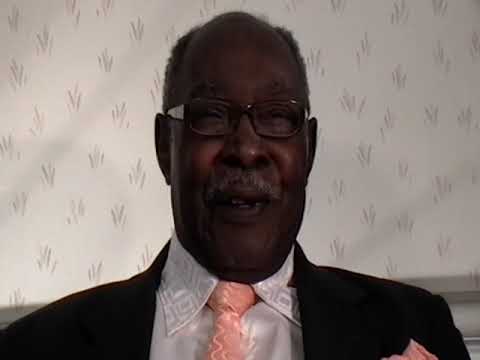
Claude Sitton: Today is January the 5th, 2012. I'm Claude Sitton, I will be the videographer and conducting the interview of W.F. W.F McIntosh, Jr. And also accompanying him and being here with me is Robert Caldwell. We call him Coach Mac most of the time. Coach, it's good to see you.
W.F McIntosh: I'm glad to be here, even if it is my lunchtime bed hour.
Claude Sitton: Uh-oh. Well, we won't take too long. I'll pan over here and see if we can pick up Robert Robert Caldwell. Robert, it's good to see you today.
Robert Caldwell: Thank you. It's good to be here.
Claude Sitton: Coach, I want to talk to you a little bit. I should call you coach, preacher, administrator, teacher - a little bit of everything. Ministry; you've done it all.
W.F McIntosh: Yeah, but don't get into that second list.
Claude Sitton: I hear you. I want to talk to you about the school system in Burke County as you know it and remember it. Tell us a little bit about your background in the school system. As I understand it, you grew up down in Marion, South Carolina. Is that not correct?
W.F McIntosh: Right.
Claude Sitton: And from there, when did you come to North Carolina? I guess you came to Johnson C. Smith, did you not?
W.F McIntosh: Yes, I did. My high school football coach persuaded me to go there. He was from Charlotte, and he was a Smith man. And my parents - the father of Baptist Medicine they had me set up to go to Morehouse, which is a Baptist school. And two weeks before time to go, my high school football coach persuaded me to go to Johnson C. Smith, which is Presbyterian, and that created almost World War III in my house. And after leaving Johnson C. Smith University after graduation, I was headed to Dayton, Ohio for a job there. And the dean called me in and said, “We have one of our graduates that's principled in Morganton at Olive Hill High School, and he's looking for a football coach and math teacher.” And they pushed me to Morganton.
Claude Sitton: Now, what year was that?
W.F McIntosh: That was in 1949.
Claude Sitton: ‘49. And at that time, how old were you?
W.F McIntosh: 24, 25, because I spent time in the service.
Claude Sitton: All right, so did you come on that recommendation to Morganton?
W.F McIntosh: Right.
Claude Sitton: And tell us a little bit about what you observed with Olive Hill and the other school systems leading the students to Olive Hill.
W.F McIntosh: Well, let me slip this in. School was already open in Morganton, and when I came here and they took me into the room where they were holding open for me, they had a substitute in there. So she explained to me what had been done in three days. And I turned around, and I was very attracted to her, so I asked her for a date and I married her.
Claude Sitton: That fast?
W.F McIntosh: Yeah.
Claude Sitton: And I bet I know who that lady was and who that lady is.
W.F McIntosh: Yes. (Laughs)
Claude Sitton: Now it's Betty W.F McIntosh.
W.F McIntosh: That was one of the main factors that kept me at Olive Hill School.
Claude Sitton: Well, I see why you stayed now. Well, so tell us a little bit about the school system there other than finding the beautiful and lovely lady to marry.
W.F McIntosh: (Chuckles) You had three school systems in Burke County. You had the Morganton City Schools, you had the Glen Alpine School System, and you had the Burke County School System. Now Olive Hill was unique in that these were the days of segregation and all the Black students in Burke County, upon graduating from the elementary schools, had to come to Olive Hill High School in order to do their high school work. Now you had Colton out in Heartland. You had the school in East Drexel. You had Willow Tree, and you had MacAlpine up in the Glen Alpine System. But all those students were bused in to Olive Hill High School, and they stayed there until consolidation and integration took effect, and then they went to the school and there stayed home.
Claude Sitton: Well, I can recall those days when I was growing up and attending Drexel School, and the African-American students that lived down on Zion Road and Tosse Jenkins over on Amherst Road - that group - all had to catch the bus, and they went by my house a whole lot earlier than I had to catch the school bus. Is that not the case with all of the students?
W.F McIntosh: Right.
Claude Sitton: So they had to get up and get out a whole lot earlier than the white students did to travel to the school.
W.F McIntosh: Right, and then from those same areas they had to come all the way to Morganton to get to Olive Hill High School, which is located on West Concord Street, which is now a staff development system for the Burke County Schools.
Claude Sitton: Now when you got there and started teaching, what were you teaching?
W.F McIntosh: Math.
Claude Sitton: And did you teach anything else at that time?
W.F McIntosh: Yes. I did physical education at the last period of the day because we didn't have a full-time P.E. teacher. And instead of giving me a free period, they filled in this P.E. class, which I had to take care of also.
Claude Sitton: All right. So that's how you got involved in the physical education; was in the last period teaching physical education, I guess.
W.F McIntosh: Right. Now we had another problem here. They did not have a typing department at Olive Hill, and having been a clerk typist and an administrator in the Army, I was very disturbed about that. So we got together with the PTA and the Alumni Association and rounded up some tables and chairs, and we went to the Army surplus place, which was up at Swannanoa at that particular time, and brought used typewriters for $10 a piece. And I taught typing after school in order for those youngsters to have typing. And then it surprised some of the board members that we didn't have typing in the curriculum at Olive Hill when it came out in the paper that we opened up this department. So, the next year they hired a full-time typing teacher.
Claude Sitton: Well, now, when did you start coaching?
W.F McIntosh: First year I was here. That's what I came here for.
Claude Sitton: So, in other words, you were teaching math and teaching physical education, and teaching typing and coaching. So you had a full day and probably almost a full night, didn't you?
W.F McIntosh: Almost.
Claude Sitton: Yeah. All right. How many students were in Olive Hill when you came?
W.F McIntosh: We had around 475.
Claude Sitton: And that 475 came from the schools that you mentioned.
W.F McIntosh: All the feeder schools.
Claude Sitton: And when you started playing football, who did you play?What schools did you play?
W.F McIntosh: Well, we had the old Northwestern Conference. That included Lenoir, Hickory, Canton, Statesville, Carver, and Wilkesboro … and Hendersonville.
Claude Sitton: Now, what year was it that you started again? … Teaching and coaching.
W.F McIntosh: ‘49.
Claude Sitton: Now, when did you first see Robert Robert Caldwell? He didn't graduate until ‘55 or ‘56 ... ‘57. So it was a few years before you saw him play again.
W.F McIntosh: Yeah, this young man grew up in Philadelphia more or less. But the unique thing about it, his mother and my wife [are] first cousins. And that's how I got connected with his family. So when I was in grad school at Temple University in Philadelphia, I would always go around to see his daddy and mama, and they fed me.
Claude Sitton: Oh, so that's the reason you put on a few pounds, I guess. … Well, while we're talking about Robert, did you teach him all he was able to learn about playing ball and math?
W.F McIntosh: Well, he made all conference and played in the Shrine Bowl, so I think it was a little effective on him.
Claude Sitton: Well, let me pan over here and see if he's even got a smile for that. (Camera pans to Robert Caldwell) (To Robert Caldwell) What year was it, Robert, that you played in the Shrine Bowl?
Robert Caldwell: 1957
Claude Sitton: And where was that game?
Robert Caldwell: Durham.
Claude Sitton: And who did you play? What other schools and what other people were in it?
Robert Caldwell: It was North and South.
Claude Sitton: Was there another player that Coach Mac taught and coached that was also in the Shrine Bowl for a year?
Robert Caldwell: Yeah, Locke Whiteside. He's deceased now.
Claude Sitton: But the two of you played.
Robert Caldwell: Right.
Claude Sitton: So is it true that Coach Mack is responsible for you being a star?
Robert Caldwell: Well, he had some part in it.
Claude Sitton: (Laughs) (To W.F McIntosh) He won't give you all the credit you’re entitled to, will he?
Now, is it true that you two gentlemen live anywhere near each other now?
W.F McIntosh: Right across the road.
Claude Sitton: And how long has that happened?
W.F McIntosh: 40 years.
Claude Sitton: 40 years.
W.F McIntosh: In fact, I don't remember years. (Laughs)
Claude Sitton: Now, while we're talking about your family feeding him - Robert - why don't you tell me the story about when you tried to call him over to your house one time to come over there and how you finally got him over there. I'd like to hear that story.
Robert Caldwell: We used to have cookouts regularly; neighborhood cookouts. Bob, his brother-in-law - we were sitting up in the woods one day. That's what we called our park area … And he was riding a lawnmower. ‘Supposed to be cutting grass, but he cut it in shade all the time. We kept calling, “Mike, Mike, come on up, come on.” He'd ignore us. I told Bob, I said, “I know how to get him up here.” I got some pine needles and started a fire. And I don't know how he got up there as fast as he did, but he thought we were cooking.
Claude Sitton: Oh, and he saw the smoke.
Robert Caldwell: (Laughs) That's right.
Claude Sitton: (Camera pans to W.F McIntosh) (To W.F McIntosh) You got any defense to that, Coach?
W.F McIntosh: None whatsoever. (Laughs)
Claude Sitton: So you've always been led by a little smoke to...
W.F McIntosh: Right, I saw that smoke coming up through the treetops and all, and I said, “They're cooking up there.” I cut the lawnmower off and slipped on up the highway and came on up through the woods and didn't see any food out there. They were burning pine straw.
Claude Sitton: What a trick, what a trick.
W.F McIntosh: Yes, they tricked me on that one.
Claude Sitton: Well, now, tell us a little bit more about the school system. We're going to put this exhibit out for the African American Exhibit in February. This is 2012, and we're going to put it out for people here. So tell us a little bit about the school system and what kind of area you had and just where Olive Hill is located here in Morganton.
W.F McIntosh: Well, that's the corner of West Concord and New Street. And we had a wonderful time over there because we emphasized excellence, and everything had to be in top order. And we had a wonderful group of teachers that supported the program, and we had a Class A glee club, Class A band, and that was something else they didn't have at Olive Hill when I got there, so I got permission.
Claude Sitton: A band?
W.F McIntosh: Yes.
Claude Sitton: All right, tell us about that.
W.F McIntosh: Well, I got permission to start a band drive. And the Rotary Club gave the first dollar to the band drive. They were excited about it, too. And the citizens put together the funds to start this first band. And, of course, we had [a] Homecoming Parade. We set that up, and we put six and seven thousand people downtown for the Olive Hill Homecoming Parade, which was held on a Thursday prior to the Homecoming game. And that was a great community project because everybody in the surrounding areas - in town and everything - supplied the money to start that band with. And then it just exploded, and it went everywhere. And we were very proud of that, and the people waited every year for their Homecoming Parade because the unique thing about it, all the member schools of the Northwestern Conference that had bands would come and participate in our Homecoming Parade, and likewise, our band would go and participate in their Homecoming Parade. So they saw six or seven bands in the Homecoming Parade.
Claude Sitton: Now, if I recall, when I think I was in the 8th grade, I was in the Drexel Band. I played the snare drums. And the thing that impressed me with the Olive Hill School band was the High Steppers. Whoever the band director was had all those band members stepping high, if I recall, did they not? Particularly the majorettes and all. They had about as high a step as I see now in some of the military cadences on TV. Is that not correct?
W.F McIntosh: We had several band directors, but the one that stood out more than the other ones was Roy McCullough, Jr., who was a member of the band at A&T. And he integrated the procedures from the A&T band, which was one of the outstanding bands in the country, and put all that into Olive Hill Band, and that's what made them so exceptional. And when he left here, he became band director at Benedict Cards in Columbia. And they had a high-stepping band and all that, so that was wonderful.
Claude Sitton: Well, now, refresh my recollection. Wasn't there one by the name of Mara?
W.F McIntosh: Ed Mara?
Claude Sitton: Ed, yes.
W.F McIntosh: He was a drum major.
Claude Sitton: Okay. Tell me a little bit about that.
W.F McIntosh: Bruce Levin was a drum major. And they put on a show.
Claude Sitton: Okay, that's what I recall, seeing a show that they could put on.
W.F McIntosh: Down on the square doing the parade. And I said, we had 6,000 and 7,000 people downtown.
Claude Sitton: Well, now, I believe Evelyn Mara became the wife of...
W.F McIntosh: Ed Mara.
Claude Sitton: Yeah. We have some artifacts here at the museum that she has given us.
W.F McIntosh: They were both members of my church, at Green Street Presbyterian Church.
Claude Sitton: Now, was Robert ever in the band, or was he always throwing and kicking that football?
W.F McIntosh: He was our little singer. Wanted to hit somebody, well, and he was in the singing group and all that, but he was a rough and tough, crunchy boy.
Claude Sitton: Okay.
W.F McIntosh: Raised up in the city.
Claude Sitton: Okay. Now, Robert's wife, Ola, she worked at the school at one time, did she not?
W.F McIntosh: She graduated from Olive Hill, and then she became the school secretary.
Claude Sitton: Okay.
W.F McIntosh: She went to school in New Jersey prior to coming back here. Her family and all were here. And then she was a basketball star.
Claude Sitton: She was?
W.F McIntosh: Oh, yes.
Claude Sitton: Well, now, we always... Robert and I tease her about being a member of the Francis family. She says they were the best-looking family in the whole county. Any truth to that?
W.F McIntosh: I can vouch for that. It was a nice-looking group of people. Oh, come on.
Claude Sitton: Now, many may say it was the McIntyres. I mean the McGintys.
W.F McIntosh: They were fine-looking people. Oh, yeah. And her brothers and all tried to excel in what they were doing and their looks and so forth. They were very particular about their appearance.
Claude Sitton: Yeah. Well, now, in some of these games, did anything unusual ever take place, either at Olive Hill or any of the other schools that you recall, that Robert might recall?
W.F McIntosh: Well, back in the days... See, the state now requires that you have police protection at the game. And back in the days when this was not a requirement, we had all football games and whatnot. It was nothing for fights to break out. And you had to be very careful with your players that they didn't get involved in this and get hurt. Something going on up in the stands.
But now there's taking on a different attitude because I know at Freedom, we had to spend quite a bit of money just paying the people to work at the game, including three and four policemen on duty, which was good for the public protection. And people have grown up now and matured. But sometimes you see it on TV, you think they're going back to the same thing. But you don't have near the structure going on now that you had back in then.
Claude Sitton: You didn't have the protection. Now, you know because you ended up, after segregation ended and integration became a part, you went to Freedom and were a coach and administrator there, were you not?
W.F McIntosh: I wasn't a coach at Freedom. I was an administrator. I went to Morganton High. And I ended up there as the line coach. We coached Broome for several years.
Claude Sitton: That was Earl Broome, was it not?
W.F McIntosh: Right. And then I became the building principal.
Claude Sitton: Right. Well, now, Robert, while we're on this topic about things taking place, anything in particular at any school or any game that you recall that you can tell us about Coach Mack and the other football players?
W.F McIntosh: Yeah, I can remember, as he said, back in the day, under the Gastonia, I believe we were playing, or Belmont. Anyway, there wasn't any scores until the second half and we came out and wore them out. Maybe like that one bit. After the game, they started throwing bricks and pangs at the bus.
Claude Sitton: People in the stands?
W.F McIntosh: Back in the day, Coach Mack jumped off a 15-foot wall. You boys better come on! You better come on!
Claude Sitton: To get away from the bricks.
W.F McIntosh: I never will forget that.
Claude Sitton: I bet not.
W.F McIntosh: That got pretty serious because they broke in the gym and cut up other boys' clothes.
Claude Sitton: Oh, goodness.
W.F McIntosh: And broke a glass out of the bus.
Claude Sitton: They were poor losers, were they not?
W.F McIntosh: Exactly, and I laid it to them legally-wise.
Claude Sitton: Oh, good.
W.F McIntosh: So they had to pay for the boys' clothes and they had to pay the bus company for that. Because we didn't do that type of thing when people came to play us here. The fans were very, very good and good rapport and everything. I expected the same thing going to other teams. Hickory was bad about fighting and we just didn't uphold that type of thing.
Claude Sitton: Well, now let me ask you something. Recently, you and I were talking about the days of segregation and there was a young student with us, a senior in high school. He did not realize that the schools had been segregated up until Brown vs. Board of Education. So tell us a little bit about that and also tell us a little bit about the difference in the schools and uniforms and fields and so on at that time. Were they really equal, the Blacks and the whites?
W.F McIntosh: Well, we played all other games in the Morganton High Stadium and we were part of the Morganton City Schools. But we didn't have a stadium of our own. But we practiced at a site across from the school and then owned by Drexel Furniture Company. And then when they expanded the Drexel Furniture Company to plant over there, we had to go down to Mountain View Recreation Center and practice.
Claude Sitton: That's on the other side of Morganton, on the side of town.
W.F McIntosh: Right, and the school system built us some dressing rooms. Now we had the best dressing rooms in the county because they built them under the Mountain View School there. But our boys had to walk all the way across town to go to football practice. And by the time we got dressed and got on the field to practice, the boys at Morganton High were through practice and going home.
Claude Sitton: Well, maybe that's the reason that you were in better shape and beat a lot of the opponents.
W.F McIntosh: Well, that could be a part of it, too. But that disadvantaged us.
Claude Sitton: Well now, Robert, let me ask you as a participant and as a player, do you feel like that you got as good a uniform and equipment as you saw at some of the other schools?
Robert Caldwell: No, we got our first new uniforms in 1956. We were playing North Wilkesboro, and we didn't get them until halftime. The principal at that time was J.V. Morris, and he brought the uniforms to the game, and we changed at halftime. The other uniform we used was Morganton High School's old uniform. We had to put tape around the legs of them so that they'd fit us, and they would just...
Claude Sitton: Tape the pads in.
Robert Caldwell: Right.
Claude Sitton: Well, that's a shame, but I just wanted to point it out because now I look back and see it and think, well, why didn't we do better? But it was one of those days that it just didn't happen.
Robert Caldwell: Our first new uniforms we ever had was in 1956 in North Wilkesboro.
W.F McIntosh: And the School for the Deaf provided us with our shoes.
Claude Sitton: Is that right?
W.F McIntosh: Coach Doug Howard was very good to us, and he saw to it that we got shoes and things for the players.
Claude Sitton: Well, I'll be sure and tell him. He is president of our Sunday school class, so I'll be sure and pass that along to him now.
W.F McIntosh: Yeah, well, he was very good to us, and Earl Broome was good to us, providing us with things that we needed. We didn't have the funds to buy them. We didn't recognize or realize that much fundraising at the game because of the number of people attending, so here we were caught across the barrel.
Robert Caldwell: Well, another incident that happened, too, was a misfortune. We were in North Wilkesboro, and Johnny Largen, who was an outstanding athlete, football player, hurt his right foot. Well, he was on the sideline, and Coach Mac took his shoe off, and Johnny had lost a toe scraping the baseball field down Mountain View. And Coach Mack grabbed that sock and started trying to get that toe to fall out.
W.F McIntosh: He did not know he'd lost it. He didn't know he'd lost it. We tried to get that toe so it could be reattached to his foot, and somebody tapped me on the shoulder and said, He doesn't have a toe. Oh, gosh.
Claude Sitton: That reminds me, I had a classmate in Drexel that had lost his index finger. His brother, when he was a kid, was chopping wood, and Roy was holding the stick of wood, and his brother came down with the axe and cut off his finger. But he was a great ball player and could use those other fingers and grip a bat, throw a ball, and do a whole lot of things. So I guess you learned to do a lot of things.
W.F McIntosh: Well, one other thing I would need to point out here. Now, when I graduated from Johnson C. Smith, I couldn't go to... When I said I couldn't, black teachers could not go to a graduate school in North Carolina. That's why many in my generation ended up at New York University, Columbia University. And I went to Temple in Philadelphia. And we had to go out of state to get graduate courses. And we got through with all of that and got back here and things started settling down. Then everything opened up. So I ended up also going to Appalachian because...