
Interview with Charles Forney
Description: Charles Forney was born in Morganton and attended first and second grade at Olive Hill School. Mountain View Elementary School opened in 1957, and Forney transferred there. His family lived on West Concord Street, and his parents were involved in organizing among West Concord families to have their children transferred to the all-white schools in their neighborhoods. His mother Ruth Forney was part of the Seven Mothers. Because of his families’ efforts, Forney was among the first wave of Black students to desegregate public schools. In 1963, he transferred to Morganton Junior High, a formerly all-white school.
Date: 2015-10-01 Location: Morganton, North Carolina
Interviewer: Claude Sitton; History Museum of Burke County
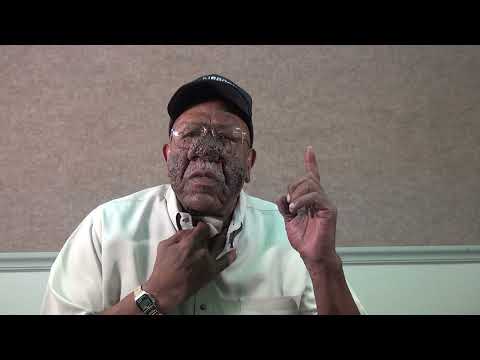
Today is October the first, 2015 and I’m Claude Sitton, interviewing Charles Forney. Charles, if you will, introduce yourself. Tell us a little about yourself.
Charles Forney: Well my name is Charles William Forney Jr. I was born in Charles at Route 40, February 26th, 1950, in Morganton, North Carolina.
Claude Sitton: Alright, and I want to ask you a question sort of out of order concerning your speaking. Have you had some problems with your voice?
Charles Forney: Well I [pause] in 2002 I started having problems, and then I went to the doctors, and then they referred me to Hickory and they told me what was going on then.
Claude Sitton: Alright and what was going on?
Charles Forney: Well I had 28 tumors on my voice box at that time and the [pause] I had two opinions and both of them came up to remove it.
Claude Sitton: Okay, so you’ve been putting up with a problem of speaking so to speak for about 12 years I guess.
Charles Forney: Well it's been 12 years since I’ve had my voice box removed.
Claude Sitton: Right. Alright, tell us a little bit about your growing up and introduce yourself concerning your family.
Charles Forney: Well okay I was [pause] growing up here in Morganton. I went to a first and second grade at Olive Hill High School. Then in 1957, they transferred us to Mountain View Elementary school. And there we progressed up to the 7th grade. And then my parents, all of the parents over here on West Concord Street, got together and formed a union. Because we had to walk from this side of town, West Concord Street, to Mountain View every day, back and forth. Alright they got us a bus, but that wasn’t us cause they started charging too much. And then they petitioned to get us to go to Morganton Junior High School in 1963.
Claude Sitton: Alright now, at that time how old were you and what grade were you in?
Charles Forney: In 1963 I was 13 years old and I was [pause] in the 8th grade.
Claude Sitton: Tell us a little bit about being integrated into the Morganton Junior High and how you got along and how the teachers got along with you and the other students.
Charles Forney: Well, from my perspective [pause] it was about fifty-fifty. Because I played ball with most of the guys that I went to school with, outside on the weekends, the sandlot football, so I knew most of the guys I was going to school with. And so really me myself personally, even though the prejudice was there, I didn’t receive any of it.
Claude Sitton: Well now after you stayed at Morganton Junior High, how long did you stay there before you went to Morganton High School?
Charles Forney: Well I stayed there until 1964. And then we moved up to [pause] Morganton High School in the 9th grade.
Claude Sitton: Okay. How many African American students were at Morganton Junior High School with you?
Charles Forney: [pause] I believe in total it was [pause] I believe it was seven.
Claude Sitton: Okay. And then when you went to Morganton High School of course it was a greater number right?
Charles Forney: No. It reduced. It came down about [pause] It came down to five in Morganton High School in 1964.
Claude Sitton: Okay. Do you remember at this time any of those other people that were in uh Morganton High School with you, African American students?
Charles Forney: Okay it was Eugene Thomas, Patricia Thomas, Lorraine Johnson, Richard Johnson, and myself.
Claude Sitton: Okay. How did you and those students get along with the other students and the teachers?
Charles Forney: Well again, I got along because I played sports and you know, I really didn’t have no problems.
Claude Sitton: Let's talk about football. What position did you play most of the time?
Charles Forney: Most of the time I played defensive end and offensive end.
Claude Sitton: Okay, did you play basketball?
Charles Forney: Yes. I played all of the positions on the basketball team because I could jump. And I played all of the positions.
Claude Sitton: Okay. So how did you get along with the coaches and who were the coaches at the Morganton Junior, at the Morganton High School?
Charles Forney: Well I started off with Coach Brunes and football. And we got along really good as long as you did as he said. Cause that’s what we was there to play ball and do as you was told. And then I went to play basketball and that's when my grill started cause coach Garway I was playing JV ball at the time. He saw me playing, then he moved me up to varsity.
Claude Sitton: And what grade were you in when you moved up to varsity?
Charles Forney: Tenth.
Claude Sitton: Tenth, okay. Well how did you and the other African American students get along at the time?
Charles Forney: At that time [pause] it was fairly well [pause] well lets say fifty-fifty comparison. And this is ‘64. But as the years progressed things got worse.
Claude Sitton: Is that right? In what way?
Charles Forney: Well in 1965 [pause] when they integrated the schools and brought all the people over there, it was a lot of turmoil. And hatred was born on then.
Claude Sitton: And what was really happening?
Charles Forney: Well whites and Blacks wasn’t getting along together.
Claude Sitton: Were there any fights, or?
Charles Forney: Yes there was numerous fights.
Claude Sitton: Okay. And how were you treated once you went to the principal's office or to the coach or whoever it might have been?
Charles Forney: Well [pause] well to tell you the truth, the principal shooed at us, and then told us to go ahead and quit school and go to work at the factory, Drexel factory, which all of us refused to do.
Claude Sitton: Who was your favorite teacher if you had one?
Charles Forney: [pause] It was my driver's ed teacher. [pause] God, I can’t think of his name.
Claude Sitton: Well I’ve heard some others speak of a teacher named Put or Putney.
Charles Forney: Well Putney was, he was an inspiration. He’d tell you just like it is. I’mma tell you what I want you to know, and then I’m gonna come back and ask you. And that’s the way he did it. But he was a good teacher. Galloway was a good teacher. And Mrs. Setzie, she was a good teacher. And Miss, Miss Kidd. She was a very good inspiration to me. Well, outside of Mr. Mack.
Claude Sitton: You’re talking about coach Mack?
Charles Forney: Right.
Claude Sitton: That’s W.F. McIntosh. All right. Well, how did he get along with all of the students, white and Black?
Charles Forney: Well, I can only speak from [pause] where I was involved with in his classes. And he, he was in control. And everybody enjoyed him, because he had that humorous type about him. And always, everything he said had a humor to it.
Claude Sitton: Well, now, did you finish Morganton High School?
Charles Forney: No, I went to the 12th grade, and I dropped out. And I went to the Army in April 18, 1969.
Claude Sitton: Was this your choice to go to the Army and drop out of school, or were you?
Charles Forney: Yes, because my parents didn't even know.
Claude Sitton: Okay.
Charles Forney: I dropped out of school, and the next morning, I went up to see Sargent Oak, at the old post office building, and went and got it, because I was 19. And I remember when I went and I called my parents when I got to Fort Bragg and let them know where I was.
Claude Sitton: That was a surprise I bet. Well now, how long did you stay in the Army?
Charles Forney: I stayed in the Army, well it was a three year hitch. But I got out [pause] January the 24th, 1972. I supposed to get out in April but they gave us early out.
Claude Sitton: What did you do after you got out of the Army?
Charles Forney: Well when I got out of the Army, I searched for jobs but I wasn't satisfied with them, because I didn't have my high school education. So I enrolled in West Piedmont in the GED program. And I completed that and then I enrolled in West Piedmont regular classes. Where I obtained an AAS degree in criminal justice and police science. Then I transferred to the GOLD program of Gardner Webb. And then I went ahead and completed that where I got a B.S. degree in that, in 1984.
Claude Sitton: And then what did you do after that?
Charles Forney: I went to work with private security. I started at Valley Mall. Then I transferred to, back then it was CCOL, fiber optic company. But now it's Corning's. And I worked there until I retired.
Claude Sitton: Tell me a little bit about your family, your wife and children.
Charles Forney: Well my wife is Ada. My kids are Hazel, Myra, and Darren. The girls are 47 and the boy is 45. Darren is in Texas. He's a principal at a middle school out there in Texas. Hazel, she works down in Greensboro. And Myra, she works here. She works out of the Love Retirement Community. Love Retirement Center.
Claude Sitton: Do you have grandchildren?
Charles Forney: I have [pause] eight. Eight grandchildren. And two great-grandchildren.
Claude Sitton: Okay. Well Mr. Forney, anything else you want to tell me about your experiences during the time of integration and even segregation? As to going to social events here in Morganton, say the movies or going to the recreation center or anything of that nature?
Charles Forney: Well, all in all, back in ‘63, the NAACP, we marched to the Collett Street Recreation Center to go play ball and they wouldn't let us in. And then they turned around and gave us the armory all over here to play ball. But we didn't let it stop right there, we just kept on and kept on being patient until we got in. But at this time, I was still in Morganton High School and Junior High School.
Claude Sitton: What about going to movies?
Charles Forney: Well, back then, the Blacks sat up at the top.
Claude Sitton: [background noise] Go ahead.
Charles Forney: The Blacks had to sit up at the top of the movies and the whites sat down at the bottom.
Claude Sitton: What about going to restaurants?
Charles Forney: Well, Woolworths, they wouldn't let us come in and eat. And we kept on and kept on until we got that established.
Claude Sitton: Okay. Anything else that you particularly recall that you want to tell the students who may be watching this film in the future?
Charles Forney: Well, yes. Be patient, courageous, and outgoing. And don't get deterred. Go ahead and make your accomplishment in life. No matter what color your skin is, you can do it. You can accomplish greatness if you put yourself to it. Don't let nobody deter you from that.
Claude Sitton: Well, Mr. Forney, I appreciate our interview, and I think your summary sort of sums it up as to life in general. And I appreciate your attitude and what you've done for this community. On behalf of the History Museum, we thank you for this interview.
Charles Forney: And I thank you, Judge.
Claude Sitton: Well, thank you very much.