
Interview with Lucille Johnson Rutherford
Description: Lucille Johnson Rutherford grew up in Glen Alpine and went to McAlpine Elementary School. Johnson was one of the Seven Mothers who called themselves the West Concord Mothers. Other mothers include: Ms. Laura Thomas, Ms. Willett Chambers, Mildred Largent, Annie Hicks, Ruth Thorney, Rose Johnson. These mothers worked with local preachers and churches to challenge school segregation in the 1960's, advocating for better educational opportunities for their children.
Date: 2015-08-23 Location: West Concord Street, Morganton, North Carolina
Interviewer: Claude Sitton; History Museum of Burke County
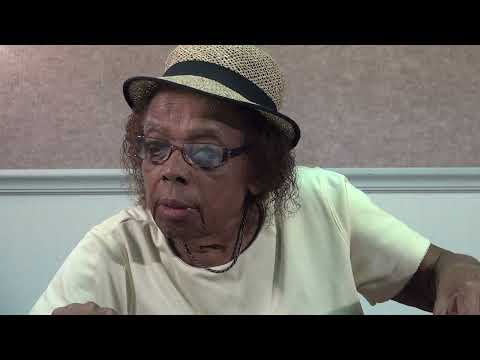
Claude Sitton: Today is August the 23rd, 2015. I'm Claude Sitton interviewing a couple of people concerning desegregation in Burke County in the years around 1964-65 in that area. First of all, let me ask you to introduce yourself to us.
Lucille Rutherford: I'm Lucille Lytle Johnson Rutherford from Glen Alpine.
Claude Sitton: All right, tell us a little bit about your growing up and what you did, where you went to school.
Lucille Rutherford: My parents was Thomas and Sadie Lidle of Glen Alpine, and I grew up, I went to MacAlpine School in Glen Alpine. It was a little old school where we had to make fires, get wood in, get kindling in for this afternoon so they have fire the next morning. And we had an outside toilet, but we had a lunchroom somebody cooked.
And when we finished, we had the bus and we had to go to Olive Hill School.
Claude Sitton: Now, Olive Hill was the high school, right?
Lucille Rutherford: In Morganton Because you couldn't go to Glen Alpine. We lived in Glen Alpine, but you couldn't go to Glen Alpine White School. And we went on the bus whenever the bus would run.
Because you couldn't go to Glen Alpine. We lived in Glen Alpine. We couldn't go to Glen Alpine White School. And we went on the bus whenever the bus would run. Most time, the bus would be to us. We got the bus that the other kids, the white kids had used them first. And when they started getting in trouble, they passed them on to the McAlpine kids. That was us.
Claude Sitton: They said then that things were separate but equal, but it wasn't so. Is that what you're telling me?
Lucille Rutherford: It was separate. It was not equal, because we'd done the best we could, but we was, nothing was equal. And we got the buses that bring us in.
Sometimes the bus would stop and be on the side of the road half a day or whatever, and then we didn't get to go to school. We'd stay with the bus. They'd take us back home.
So we went to Morganton High School, Olive Hill. That was for four years. Then it went to 11th grade.
And we graduated 11th grade...[hesitates] you need to ask me questions.
Claude Sitton: All right. Now, how long did the transportation take you to get from your home to Olive Hill when you were going to high school?
Lucille Rutherford: We left, we'd catch on the side of the highway, on a certain highway. It'd take anywhere from, if the bus was in good shape and went on down, we'd get there in the inside of 30 minutes. Okay.
Claude Sitton: And what time did you get home?
Lucille Rutherford: School, got out at 3 o'clock, 3.15 or 3.30. And we'd come straight home after school. [Phone Rings] And in about 30 minutes, you would be back home and you'd let your outside road. We all lived off the highway, but then we'd walk on home because we had chores to do at home.
We had to come home and do farm work.
Claude Sitton: Okay Now, how many students do you recall was in your class at Olive Hill, roughly, each year?
Lucille Rutherford: Hmm. In my class, I'd say that, you're talking about the rural, we went, well, we had a class from Oak Hill, and it wasn't, Glen Alpine, Beartown. It was empty.
We didn't have, we wasn't with the white kids.
Claude Sitton: Right.
Lucille Rutherford: All black kids. We'd have, say, about 10.
Claude Sitton: All right. And all your teachers were?
Lucille Rutherford: Black.
Claude Sitton: African American teachers. Okay. Now, directing your attention to about the year of 1960s, maybe 64 or 65, how old were you and where were you in school at that time? What year did you graduate from high school?
Lucille Rutherford: I come out of school in about 48.
Claude Sitton: Okay.
Lucille Rutherford: I didn't graduate. I left, I finished the 11th grade. All right. And I, and that's when it was putting on the 12th grade. And that was in 48.
Claude Sitton: Well, so you were already out of school and your children were involved in your situation? At the time of desegregation?
Lucille Rutherford: Yes. I had two children, Richard and Lorraine. Okay. Was my, us kids, we went to, we moved to Morganton during that time. We, I had moved to Morganton on Bush, on the upper Bush Hill Street with four children, because I had gotten married and had four children. And Richard and Lorraine were my older kids. And they went to, they was high school. They went to Mountain View. And when they finished, when they got out of Mountain View, they had to go all the way across town when they had to pass, what was that, grammar school down there?
Claude Sitton: Down at the corner, now it's the county building, I guess, near where Lazarus used to be.
Lucille Rutherford: Yeah.
Claude Sitton: Okay.
Lucille Rutherford: Well, we had to pass there to go to Olive Hill. And Olive Hill had school for all of the, for up to the 12th grade. Okay. From the first to the 12th. And they had to pass there to go to Olive Hill, the school in the small, in the, in the smaller grades.
Claude Sitton: Right.
Lucille Rutherford: Third, fourth, and fifth. But as when my children got in high school, Richard and Lorraine, they went to Morganton, went to Olive Hill, went to Morganton High.
Claude Sitton: All right. Now, did they ever start at Olive Hill before they transferred to Morganton High School?
Lucille Rutherford: No.
Claude Sitton: Okay. Now, somebody has told me that you are one of seven African-American women who were very influential in being involved in the process of desegregation.
Lucille Rutherford: Yes.
Claude Sitton: Can you tell me who these women, other women, were?
Lucille Rutherford: It was [hesitates] Ms. Laura Thomas, in the early 60s, seven mothers, Ms. Laura Thomas, Ms. Willett Chambers, Mildred Largent, Annie Hicks, Ruth Thorney, Rose Johnson, and Lucille Rutherford.
Claude Sitton: And that's you?
Lucille Rutherford: That's me. And they called, we called ourselves the West Concord Mothers.
Claude Sitton: All right. What did you seven women do, and what was your approach to helping to desegregate the school system?
Lucille Rutherford: We worked with, we worked with the preachers. They was our leaders. Reverend Hunt, Shallow Hunt, he passed at Shallow Church, AME Church. The Reverend Hunt at Slades Chapel, he was at Slades Zion Church, and they were our leaders. We had meetings, all this in here. We had meetings and met with them, and prayed, and we went to,...[hesitates]... met with the principals, superintendents.
Claude Sitton: All right. Now, we're talking about the school system. Let's talk a little bit about the community and the community situation. What can you tell me about the situation with the African-Americans and recreation in that area? Did you have any facilities that were mainly for African-Americans at that time?
Lucille Rutherford: Yes. My daughter played ball, Lorraine Johnson. When she went to Morganton High, she went out for the basketball. With the school and made the team. And she played with the school. And that was about all we had.
Claude Sitton: All right. All right. That's after you got into or your kids got into the integration. That is, in Morganton High. Before, did you have another facility that they had to go to or did go to? Before, did you have another facility that they had to go to, or did go to?
Lucille Rutherford: No.
Richard Rutherford: What do you talking about Mountain View, swimming.
Lucille Rutherford: Mountain View, they couldn't go swimming.
Claude Sitton: Well, you said the hunting.
Lucille Rutherford: The mountain, we had, the recreations had swimming pools.
Claude Sitton: Okay.
Lucille Rutherford: They would not let the black children swim at College Street.
Claude Sitton: College Street. Go ahead.
Lucille Rutherford: Till our children would go, they went to the river, and we had four children or more that got drowned. They was getting drowned in the river.
Claude Sitton: In Silver Creek, Catawba River? Hunting Creek. Hunting Creek.
Lucille Rutherford: It was on Hunting Creek, and they got drowned, and Ms. Henry Wilson got involved, and she talked to us. We would talk to her in the afternoon, and she worked hard with some other, with the pastors, and get, so Black children could go swimming at College Street, and it wasn't easy. It was a hard test, but they got to do it, and finally, they opened up Mount Oak, when they seen our children, all our children getting drowned, sitting there, there was two or three children got drowned from one family that ain't had his voice.
You remember that? And so, when they let us go swimming, opened up and let us go swimming, it was still rough, because when the children go, the white children was mean to our children. Parents said, I had to go.
I went with mine. I walked them to school. When they went to school, I'd get up and walk my children, go to school with my children, then come back home and go to job.
I worked in Valdese. I worked at Grace Hospital several years. I went to Valdese, then go to work, and then be back home. You have to be back, to walk back with them, but you had to do the hours on the job, and it was rough.
Claude Sitton: I said they were mean to them in what respect?
Lucille Rutherford: Fighting them, spit on them, and just didn't call them, and called us all kind of names, and then the teachers never called them Negroes. They called them ni***rs. The teachers throwed off on our children, but we had to hold our head up and take it.
Claude Sitton: Now, was these teachers in Morganton High School?
Lucille Rutherford: Teachers was the Morganton High School teachers. It was not accepted. Some was nice, and some was nice because they had to be nice because of the law, and then others showed their real self, but we didn't, and our children would fight back.
We told our children to fight back. You had to fight back so you wouldn't get hurt. When we met with the, I believe David Oates was the- Sheriff?
Was the sheriff. We met with him, and we took our complaints to the sheriff, and somebody else, and he told, and in some places, they was burning sheets in Black people's yards at night.
Claude Sitton: Well, now this time, as I recall, he had one deputy, Junior Davis. Junior Davis. Was he of assistance to the African-American community in his position?
Lucille Rutherford: Well, no, but he would be there, you know, but Mr. David Oates told us, if a sheet jumped right in your yard, you got my permission to shoot the sheet because the sheet don't walk.
Claude Sitton: And what yards? Was it in Morganton?
Lucille Rutherford: We didn't have no sheets in my yard, in the city limit. Now, I can't say for sure, but they was in the rural district, up shallow area. I believe they was, I used to know the man's name. Somebody shot the man's arm.
Richard Rutherford: Oak Hill.
Lucille Rutherford: Oak Hill area. There was sheets jumped around in the yard.
Richard Rutherford: There was some in Morganton, I was correct.
Lucille Rutherford: Was it?
Claude Sitton: All right, now this, this is your son that's talking, Richard. I'm going to interview him in a minute, so maybe.
Lucille Rutherford: Let me, let me, let me think some more.
Claude Sitton: Okay. Were the other, was there other trouble in town or out in the country that you drove?
Lucille Rutherford: Riding the buses.
Claude Sitton: Okay.
Lucille Rutherford: You had to, we rode that little green city bus, because people didn't have cars back then like they do now. And we'd have to fight to get on the bus and fight to get off the bus because we couldn't drive nothing but the back seat. And when the white people get on the bus, they'd go to the back seat and sit down.
They wouldn't get up. And we stand in the front of the bus, but I would tell you, can't stand up here. You got to go back to the back.
We, well, we, then they stick their leg out, try to trip you when you try to go to the back. So, Mr. David Oates told you, told us to fight back, protect yourself.
And that's what we're doing. So we finally broke, whatever it was, we broke it down.
Claude Sitton: To your knowledge, did anyone get hurt badly?
Lucille Rutherford: No, they didn't get hurt badly, but they got hurt enough that they stopped. [laughs]
Claude Sitton: Right. Overall, do you think that the seven mothers that you referred to, West Concord mothers, did a great job?
Lucille Rutherford: They done a great job. And the preachers told us not to, they, the men would go, the men couldn't go because they didn't think that they wouldn't hurt the women. But, but the men was in the background.
If they had to, they was with us, but they was, they stayed out of sight.
Claude Sitton: Okay.
Lucille Rutherford: And they sent all the women. We marched, we marched in Morganton, marched the streets, and nobody got hurt. But, but the women went by themselves.
Claude Sitton: How many people would participate in the marches?
Lucille Rutherford: Most of the seven women, but most of the Black people scared, was afraid.
Claude Sitton: All right.
Lucille Rutherford: Of getting hurt, and because people, people would go after them with, with things to really hurt them with, you know.
Claude Sitton: All right, let's change the areas a little bit and talk about African Americans being served in restaurants and places of that nature. What was the situation about this time?
Lucille Rutherford: When they wouldn't serve you, they had windows open. You go to the, by the window to get a sandwich. You remember that?
Richard Rutherford: Mm-hmm, I was doing that time.
Lucille Rutherford: And, and, uh.
Richard Rutherford: Actually, I'd have to go to the back most of the time.
Lucille Rutherford: Yeah, you go by the window. They wouldn't let you come in the front door of the, of the cafe up, up on, on the street. And, uh, then they, they tell, tell you that they didn't serve people in the race.
Claude Sitton: Mm-hmm.
Lucille Rutherford: We tell them we're not trying to buy one of them. We want a sandwich. And they had Black cooks.
Older Shade was one of them. Who was that other one? There's a man in town with the other one.
I don't remember his name. Greenlee? I believe his name was Greenlee.
Claude Sitton: Okay.
Lucille Rutherford: Anyway, uh, they wouldn't, they wouldn't serve us, and we wouldn't quit. We just stay there, and they push as we push back.
And they, uh, we're going out, then we go to, uh, where in Chicago, what was that, uh, Woolworth was uptown. And we'd go and sit down to be served. They wouldn't serve us, so we'd sit there.
And after we, when we got to fighting back, they wouldn't put their hands on us. They wouldn't serve either. You used to have to sit there.
And they had an eating place in there. Kibble Drugstore had a place where you could eat. They wouldn't serve us either, so finally they closed them, because they wouldn't serve us.
They would, they closed the, the, the, the, where, where they serve food. Woolworth's, they sold this, uh, closed that down. And, uh, they just refused to do it.
And they had, uh, Black people doing the cooking. And they called you all kind of names. You had to, you had to be tough and be able to take what they called you, as long as they didn't put their hands on us.
And, uh, and they called us all kind of names.
Richard Rutherford: Probably the first places in Morganton that you could go in and eat was Burkemont Hotel, the kitchen area. You could go in and sit down and eat there. Used to be across the street from Winn-Dixie. And the two pool rooms started letting you come in and eat.
Lucille Rutherford: They were probably the first facilities to let, yeah, the first facility to let you go in and sit down and eat.
Claude Sitton: All right. Now, let me suggest that we sort of stop, uh, and then I'm gonna ask you to change seats and I'll, uh, interview your son. And, uh, then we may come back and have more discussion.
So I'm just going to stop it now and then we'll start back in just a moment.