
Interview with Andrea Chambers Lytle (2015)
Description: Andrea Chambers Lytle lived on West Concord Street for most of her life. She is the daughter of Mrs. Willette Chambers, one of the seven West Concord Mothers. She attended Mountain View Elementary School during segregation. In 1963, Lytle was reassigned to a special education class at Central School downtown, separated from her siblings, and one of only four Black children sent to that school. She completed half a year at Central School before the school psychologist admitted they mistakenly placed her in the special education class. She was transferred to Forest Hill Elementary School and forced to repeat fifth grade.
Date: 2015-09-24 Location: Morganton, North Carolina
Interviewer: Claude Sitton; History Museum of Burke County
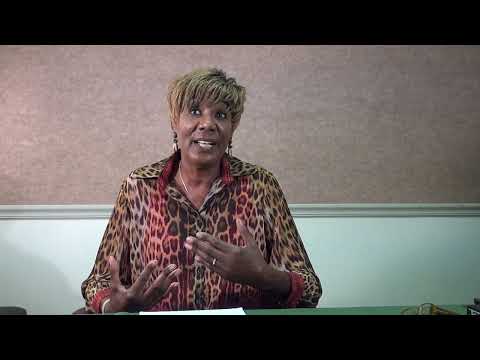
Claude Sitton: Today is September the 24th, 2015. An interview is being conducted at the History Museum of Burke County. And how are you today?
Andrea Lytle: I’m great. How are you?
Claude: Fine.
Andrea: Good.
Claude: I would like for you to tell us a little bit about yourself, where you grew up, and a little bit about your family.
Andrea: Okay. My name is Andrea Chambers Lytle, and I grew up here in Burke County. I lived on West Concord Street in Morganton for most of my life, up until about 1971, and my family built a home out on Rockyford St, where we moved. I am the middle of seven children, three younger and three older. All my siblings live here in Burke County, except for two
Claude: And what are you doing now?
Andrea: Now I work at Blue Ridge Community Action. Been there 27 years, and I'm a case manager. I work with families to help them become self-sufficient, moving them out of poverty. I also work with the Circles Program and I'm dedicated to my church and I'm a church person, and I just love people.
Claude: Well, we were conducting interviews about desegregation or integration time here in Burke County, particularly the school systems. So if you will, locate us in, within your life situation as to where you were and what you did and where you went during that period of time.
Andrea: Okay. I started elementary school at Mountain View Elementary, and then in 1965 they integrated the schools. And when they integrated the schools, they came to my parents and told them, “Well, your younger siblings will go to Forest Hill.” And my older brother and sister was in junior high and high school. And then the day came when my mother said, “Well, you don't get to go to Varsity with your siblings.” And I'm saying, “Why? That school is right here in the neighborhood.” So I had to go across town. And they put me in a special ed class, and I couldn't understand it. I know that in elementary school I was somewhat shy, more introvert because of the way the teachers was trying to correct me with my left hand and took that out on me in a sense. And then, when I went to Central, they put me and a young man named Bobby Forney–they placed us in a special ed class. There was only four blacks in the whole school, and that was Beverly Forney at the time—she's Beverly Colton–her sister Marilyn Forney—I don't know what her marriage name is. But Bobby and I was placed in a special ed classroom with developmentally-handicapped children. And to me it seemed as though we were in there to assist the teacher in helping take care of those children.
So, while in that class, I would have the psychologist from the school come along and say, “Well, we need to do some tests with you.” Well, they gave me the inkblot test, and I took that twice within that first year. That second year, they came to me and they said, “We need to test you again.” So they test me, and then a week later the psychologist met with me again, and she said, “We made a mistake.” And I said, “You made a mistake? So what are you going to do?” And she said, “Well, we have to talk to the school system, and we'll get with your parents and get back with you.” Well, they talked to my parents. And, they came back to me and they said, “Well, we're going to put you back in the fifth grade.” And I'm saying, “I completed the fifth grade, so why are you going to put me back in a grade that I've already completed?” They said, “Well, half of the school year has gone by. And so, therefore, we're going to let you go to Forest Hill with your other siblings.” I said, “But that's putting me back in the grade with my two younger siblings. Why would you do that?” They said, “Well, once again, the school year is halfway over, so we're going to put you back in the fifth grade.”
So, I went on from the fifth grade, and I felt that I was dealt a wrong hand then, and as I went on through school, I went from fifth grade to junior high school. And junior high school, during the segregation time, the kids always, you know, picked on me. They called me retard, even my brothers and sisters, you know, because I was in special ed. And that hurt. It hurt a whole lot. And then, I went from there to being called the n-word in school by not all the white folks, but some certain ones. And I became defensive and I fought. I fought, you know; I got angry, and I fought. And then in ninth grade, which was over at West Concord, as we were walking back home from junior high school, the ninth graders from the old Olive Hill School would be coming across the hill, and me and Candace and [Reveille ?] would be walking home from school, and they would take over the sidewalk and push us out in the street. And they wouldn't let us walk on the same sidewalk.
Claude: You're talking about the white students?
Andrea: Yes, the white students would push us off on the street. So, one day I told my friends, I said, “You know,” I said, “Enough is enough. We, you know, we got to take back what's ours.” So, this one guy, he was the ringleader. I said, “I'll take care of him, and you all take care of the rest of them.” So we fought our way, and so we earned our respect, and we were able to walk home from that point.
But it seems like every time I got in trouble at the school, they would call my mother. And they would say, “She was doing this, she was fighting this, and she did this to the kids,” and I'm saying, “But you're not hearing my story, you know; nobody's taking my side.” After we got into the ninth grade, there was one teacher. I can't remember her name, but she was my P. E. teacher, and she inspired me and told me—she said, “Whatever you do,” she said, “that smile and that personality that you have is going to take you far.” And she said, “Don't let anyone talk you down, okay?” So she was kind of building my self esteem as I was coming along. And from that point on, I just went on to high school. I played basketball my first year in high school. Then the next year, I was told, “You're too old.” And I said, “It's not my fault.” And they said, “But the school says that you have to be a certain age to play basketball.”
Claude: How old were you then?
Andrea: I graduated high school at age 20. So that's what hurt, because I had two years taken from me, two years out of my life during segregation time. And I feel that I was robbed those two years, you know. And so I said, “Okay, here's another blow.” So what do you do? You can't play basketball, so they made me like an assistant manager on the team.
So I did that for a while, and then I applied for college and everybody kept saying, “Well, where are you going to go?” I said, “I'm not going with you all.” So I decided I was going to go to a Black institution, so I got accepted at St. Augustine College in Raleigh. I went off there, I played basketball, I got my BS degree in Health and Physical Education with a Minor in Health, and then I applied for graduate school, and I took the graduate of record exam, and I got accepted at Illinois State.
So during the course of my senior year in undergrad, there was scouts from Burke County that came recruiting teachers for the school system. And I said, “Well, I'm going to go to that interview and I'm going to see what it's like.” So I had the interview, and when they asked me, “Well, would you be willing to teach in Burke County?” And I said, “In the way that they treated me over the years, I don't think so.” I said, “I have a graduate assistantship, so I'm going to go on to graduate school, and then I'll think about it.” And so after that, I just went on to graduate school and ended up in Chicago.
Claude: And how long did you work or stay in Chicago?
Andrea: I was in Chicago for 15 years, and while I was in Chicago I first started working with the YMCA. I wanted to teach school, but at the time I had my car stolen from me, so I said, “Well, I'm using public transportation and I don't know my way around.” So I got a job working with the YMCA and I was a director of women's programs. And then from there I went to work at Home for Developmentally-Handicapped Adults. And that's what my passion was, to work with developmentally-handicapped adults.
Claude: You’d worked there before.
Andrea: Hm?
Claude: In school.
Andrea: Yeah, I worked there in school, but I also worked back in during the segregation time when they had the programs. I can’t remember—it was through Urban Renewal, and I worked at Western Carolina Center, and I worked with the developmentally-handicapped children. And that's where I developed a passion, so when I was in graduate school, since I was in PE, I wanted to do therapeutic recreation for developmentally-handicapped adults and children. And so, when I left the YMCA in Chicago I actually worked in the field of working with developmentally-handicapped adults at a workshop setting. And I worked with them on skills and setting goals and stuff like that, and did that until I had an opportunity to go overseas and play basketball. So I went to the south of France, and I played basketball for a year, and then I took a leave of absence from my job. Then I came back and I got my job back until I came home and met my husband, Robert Lytle, who I'm married to now.
Claude: Do you have a family?
Andrea: My personal family?
Claude: Yes.
Andrea: My husband had two grown children, had a granddaughter that was born the day before we got married. And so that became my family.
Claude: Alright, during this period of time of integration or desegregation about ‘65—
Andrea: Mm-hm.
Claude: What did you experience, if anything, concerning athletics here in the County or the City of Morganton?
Andrea: As far as the athletics went, I think that the coaches—I mean, there were Black and whites on the team. The coaches
Claude: What was your situation in regard to social events here in Morganton? Say, attending movies, or going to restaurants, or—
Andrea: Well, back during that time, you know, at the Mimosa Theater, the Blacks had to go upstairs and sit in the balcony; we couldn't go downstairs. The whites had the privilege of sitting on the main floor, but we had to go in through a side door into the balcony, and that's the way we were told to leave the facility
Claude: Did you ever have any unusual experiences trying to eat in any particular public places?
Andrea: I personally didn't, but I know that the Woolworth’s store that was downtown and then the water fountains that was outside was saying for whites only, and that was what we experienced here. Didn't hang out in the downtown area too much, but we had to walk everywhere we had to go, so we were told to be home by dark so we wouldn't get in any trouble. I can't remember the year that the Freedom Marchers came through here on their way to D.C. They were at Slades Chapel AME Zion Church, and I walked with that walk, you know, as they came through Burke County, and so that was an experience for me as well.
Claude: Did you have any unusual experiences that you haven't mentioned at school that you recall that you have not brought up?
Andrea: There were some teachers that to me was sort of prejudiced, and there were some that was fair. I remember Mr. Putman, that was one of my high school teachers. I thought he was very fair, you know, and treated everybody equal. But there was some other teachers—I can't remember their names—that was in junior high. In junior high there was a math teacher, I think it was. She would ask other students to assist; instead of her coming and helping us with a problem, she would ask other students to help you. And then some of the students, being prejudiced, would say, “Well, I'm not helping that n- person.” And that would make me mad, and I said, “Okay, because you called me the n-word, I will see you after school.” And that's like I said, I had to fight my way. Finally, I have gotten over that, but that was back during that time when there was a lot of anger, you know, during the, um…
Claude: Were you ever brought into the principal's office for so-called discipline as a result of this?
Andrea: Yes, I was.
Claude: And how were you treated then?
Andrea: I don't think I was treated fairly, but every time I turned around they was calling my mother. And my mother kept telling me, “If you don't do this, go back to school and apologize. And if you don't do this, you're going to go to a reformatory school.” And that's what the principal was saying to my parents
Claude: Well now, how involved was your mother in integration?
Andrea: Well, my mother was one of the seven that met with Reverend McIntosh, and they met in the basement and it was Ruth Forney; Mildred Largent; my mother, Willette Chambers. I can't think of the other lady's name. She was a Rutherford, Lucille Rutherford. That's four or five; I can't think of all of them. But they met in the basement of Reverend McIntosh. They met in the homes and at the churches, fighting for desegregation for their children. And my mother has a—I guess there's a tape here on archive about desegregation and the seven women that worked in the community to fight for their children, to make things better for them.
Claude: Who in the so-called white community would you say were leaders in integration, if you really know?
Andrea: I can't really say. Maybe Judge Ervin; I know my mother worked for him for a long, long time, and—
Claude: Now this is Sam Ervin III, or Sam Ervin Junior?
Andrea: Senior.
Claude: The one that was the Senator?
Andrea: Yes, Senator Sam Ervin.
Claude: He was a Junior.
Andrea: He was a Junior, okay. My mother worked for him for a long time, so he was very instrumental in helping them with their cause a little bit along the way.
Claude: And you've mentioned the so-called Seven Women that were very much involved.
Andrea: Mm-hm.
Claude: What about the men or teachers or principals or anyone else that come to mind?
Andrea: Well, during the integration period, there was not a lot of Blacks—females or males—within the system during that time that I can recall. I remember Reverend McIntosh because I had some classes with him in high school, but in junior high, I can't recall one. In high school, not really.
Claude: Was there anything else that comes to your mind that you'd like to mention now for the benefit of students who may be seeing this film at some later time?
Andrea: What I would like to say to the young folks is that if you have a low self esteem, I just want you to know that you have to believe in yourself, and that there's someone else out there that believes in you and can be a role model to you and help you to reach that goal that you're setting in life. But don't give up, because I've never gave up.
Claude: Well, I want to congratulate you on the saying, “we shall overcome.”
Andrea: Mm-hm.
Claude: You took it personally and said, “I shall overcome.” And you did.
Andrea: I did.
Claude: And I congratulate you.
Andrea: That was one of the reasons for a long time I kept saying, “I'm going to leave North Carolina and I'm not going to look back.” But I'm back.
Claude: Well, I'm glad you're back, and I'm sure the community is happy that you're back, because I'm sure you've done a great job in the 27 years that you've been working in your present position. And I'd like to thank you on behalf of the History Museum for your time and coming in today and telling us a little bit about your situation.
Andrea: All right.
Claude: Thank you so very, very much.
Andrea: You're welcome.